



How does a centrifigua casting grp pipe machine ensure the roundness of pipes?
Jan 22, 2026
Leave a message
As a prominent supplier of centrifigua casting GRP (Glass Reinforced Plastic) pipe machines, one of the most frequently asked questions we encounter is about how our machines ensure the roundness of pipes. In this blog post, I will delve into the technical details and innovative features of our equipment that contribute to maintaining high - precision roundness in the GRP pipes we produce.
Understanding the Significance of Pipe Roundness
Roundness is a critical geometric characteristic of GRP pipes. In many applications, such as underground sewage systems, industrial fluid transport, and construction projects, a precise round cross - section is essential. For underground installations, a perfectly round pipe provides uniform support around its circumference, reducing the risk of deformation under soil pressure. In the context of fluid transport, round pipes offer a consistent flow path, minimizing turbulence and pressure losses. Moreover, for pipe joints and fittings to work effectively, the pipes need to have a high degree of roundness to ensure a tight and leak - free connection.
The Centrifugal Casting Process
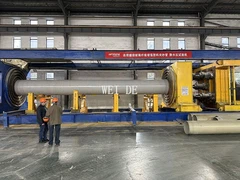
Our centrifigua casting GRP pipe machines utilize the centrifugal casting process, which inherently favors the formation of round pipes. The process involves rotating a mold at high speeds while pouring a mixture of resin, glass fibers, and other additives into it. As the mold spins, the centrifugal force distributes the material evenly along the inner wall of the mold.
The centrifugal force acts perpendicular to the axis of rotation, pushing the material outwards and ensuring that it adheres uniformly to the mold surface. This uniform distribution of the GRP material is the first step in achieving a round pipe. The force exerted on the material is proportional to the square of the rotational speed and the distance from the axis of rotation. By carefully controlling the rotational speed of the mold, we can precisely regulate the distribution of the GRP mixture, ensuring that it spreads evenly and forms a smooth and round inner surface.
Calibration and Precision Engineering
Before the production process begins, our centrifigua casting GRP pipe machines undergo rigorous calibration. The molds are designed with extremely high precision. They are manufactured using advanced machining techniques to ensure that their inner diameters are consistent and accurately round. The tolerance for the inner diameter of the mold can be as low as a few micrometers, which significantly contributes to the roundness of the final pipes.
We also use state - of - the - art sensors and monitoring systems to continuously measure and adjust the manufacturing process. During the rotation of the mold, sensors can detect any minor variations in the thickness of the GRP layer or the position of the material. If any deviation from the desired roundness is detected, the machine's control system can make real - time adjustments. For example, it can adjust the speed of the material feeding mechanism or the rotational speed of the mold to correct the issue.
Material Selection and Quality Control
The quality and properties of the materials used in the GRP pipes also play a crucial role in maintaining roundness. We carefully select high - quality resins and glass fibers that have good flow characteristics and mechanical properties. The resin should have a low viscosity during the casting process to ensure that it can flow easily and evenly within the rotating mold.
In our production facilities, we have a strict quality control system in place. Every batch of materials is tested for its physical and chemical properties before being used in the manufacturing process. The GRP mixture is also thoroughly mixed to ensure a homogeneous composition. A well - mixed material will distribute more evenly under centrifugal force, leading to pipes with better roundness.
Post - casting Treatment
After the centrifugal casting process is completed, the pipes undergo post - casting treatment to further enhance their roundness. One of the key post - casting steps is curing. The pipes are placed in a controlled environment where they are heated to a specific temperature for a set period. This curing process helps the resin to fully harden and develop its mechanical properties.
During curing, the pipes are supported in a way that maintains their round shape. Special fixtures and supports are used to prevent any deformation that might occur due to uneven cooling or internal stresses. Once the curing is complete, the pipes are inspected again using advanced measurement techniques. Any pipes that do not meet our strict roundness standards are either re - worked or rejected.
Advanced Features of Our Machines
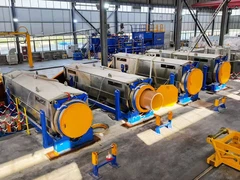
Our centrifigua casting GRP pipe machines come with several advanced features that are specifically designed to ensure pipe roundness. For example, we have developed a variable - speed control system for the mold rotation. This system allows us to adjust the rotational speed according to the diameter and length of the pipe being produced. Different pipe sizes require different centrifugal forces to achieve optimal material distribution, and our variable - speed control ensures that the right force is applied at all times.
We also incorporate a vibration - damping system in our machines. Vibration during the casting process can cause the GRP material to move unevenly, leading to variations in the pipe's roundness. Our vibration - damping system reduces the impact of external vibrations and internal vibrations generated by the machine itself, providing a stable environment for the casting process.
Applications and Benefits
The high - quality, round GRP pipes produced by our machines have a wide range of applications. In the Jacking Pipe Production Line, the roundness of the pipes is crucial for smooth installation. The pipes can be easily pushed through the ground without getting stuck or causing damage to the surrounding soil.


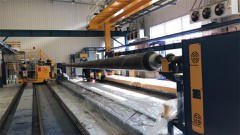
Our Centrifugal Casting Fiberglass Pipeline Production Line benefits from the round pipes as well. The consistent round cross - section ensures efficient fluid flow, reducing energy consumption and maintenance costs in the long run.
Conclusion
In conclusion, our centrifigua casting GRP pipe machines ensure the roundness of pipes through a combination of the centrifugal casting process, precise engineering, strict material control, and advanced post - casting treatment. The innovative features of our machines, such as variable - speed control and vibration - damping systems, further enhance the roundness and quality of the pipes.
If you are in the market for high - quality centrifigua casting GRP pipe machines that can produce pipes with excellent roundness, we invite you to contact us for a detailed discussion. Our team of experts is ready to assist you in finding the right solution for your specific production needs.
References
- "Handbook of Composite Pipe Engineering"
- "Centrifugal Casting Technology: Principles and Applications"
- "Quality Control in GRP Pipe Manufacturing"
Send Inquiry