



How to choose the right hardener for epoxy pipe production?
Oct 02, 2025
Leave a message
Hey there! As a supplier in the epoxy pipe production business, I know how crucial it is to choose the right hardener for your epoxy pipes. In this blog, I'm gonna share some tips on how to make that choice, so you can produce top - notch epoxy pipes.
First things first, let's understand what a hardener is and why it's so important. A hardener, also known as a curing agent, is a chemical that reacts with the epoxy resin. This reaction causes the resin to change from a liquid state to a solid state, giving the epoxy pipe its strength and durability. Without the right hardener, your epoxy pipes might not have the desired properties, like resistance to chemicals, pressure, or temperature.
Factors to Consider When Choosing a Hardener
1. Curing Time
One of the most important factors to consider is the curing time. Different hardeners have different curing times, which can range from a few minutes to several hours or even days. If you're running a high - volume production line, you might want a fast - curing hardener. This allows you to produce more pipes in less time. For example, some fast - curing hardeners can set in as little as 10 - 15 minutes. On the other hand, if you need more time to work with the epoxy resin, like when you're doing complex winding or shaping, a slow - curing hardener might be a better choice.


2. Chemical Resistance
Epoxy pipes are often used in environments where they're exposed to various chemicals. So, you need a hardener that can provide good chemical resistance. For instance, if your pipes will be used in a chemical processing plant, they'll likely come into contact with acids, bases, or solvents. You should choose a hardener that can withstand these chemicals without degrading. Some hardeners are specifically formulated to be resistant to certain types of chemicals, so make sure to do your research.
3. Temperature Resistance
Temperature can also have a big impact on the performance of epoxy pipes. If your pipes will be used in high - temperature environments, like in geothermal applications or near industrial furnaces, you need a hardener that can maintain its properties at elevated temperatures. Similarly, if the pipes will be used in cold climates, the hardener should be able to resist cracking or becoming brittle.
4. Mechanical Properties
The mechanical properties of the cured epoxy, such as strength, flexibility, and hardness, are also determined by the hardener. If you need pipes that are very strong and rigid, you'll want a hardener that produces a high - strength cured epoxy. For applications where some flexibility is required, like in pipes that need to bend slightly without breaking, a hardener that provides a more flexible cured epoxy is a better option.
5. Compatibility with Winding Machines
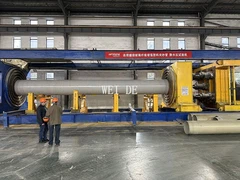
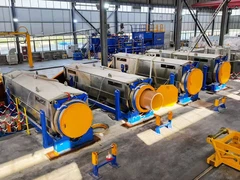
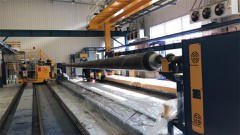
As an epoxy pipe production supplier, I often use machines like the Epoxy Horizontal Winding Machine, High - pressure Petroleum Pipeline Production Line, and Epoxy Pipe Winding Machine. It's important to choose a hardener that is compatible with these machines. Some hardeners might have a viscosity that is too high or too low for the machine's operation, which can lead to problems like uneven winding or clogging.
Types of Hardeners
1. Amine - Based Hardeners
Amine - based hardeners are very common in epoxy pipe production. They offer good chemical and temperature resistance, as well as fast curing times. They're also relatively easy to handle. However, some amine - based hardeners can be toxic, so proper safety precautions need to be taken during handling.
2. Polyamide Hardeners
Polyamide hardeners are known for their good flexibility and adhesion. They're often used when you need pipes that can withstand some movement or vibration. They also have a longer pot life compared to some other hardeners, which gives you more time to work with the epoxy resin.
3. Anhydride Hardeners
Anhydride hardeners are typically used for high - temperature applications. They can provide excellent heat resistance and mechanical properties at elevated temperatures. However, they usually have a longer curing time and require higher curing temperatures.
Testing and Quality Control
Once you've selected a potential hardener, it's essential to conduct tests before full - scale production. You can perform small - scale tests to check the curing time, chemical resistance, and mechanical properties of the cured epoxy. You can also test the compatibility of the hardener with your winding machines.
Quality control is an ongoing process. Regularly test the pipes produced with the chosen hardener to ensure that they meet the required standards. This will help you catch any issues early and make adjustments if necessary.
Conclusion
Choosing the right hardener for epoxy pipe production is a complex but crucial decision. By considering factors like curing time, chemical resistance, temperature resistance, mechanical properties, and compatibility with your winding machines, you can make an informed choice. There are different types of hardeners available, each with its own advantages and disadvantages. Remember to conduct thorough testing and maintain strict quality control.
If you're in the market for epoxy pipes or have questions about choosing the right hardener, I'd love to help. We're a reliable epoxy pipe production supplier, and we're here to assist you in making the best decisions for your projects. Feel free to reach out to us for more information and to start a procurement discussion.
References
- Handbook of Epoxy Resins, Lee and Neville
- Epoxy Technology and Applications, Henry Lee
Send Inquiry