



What are the main components of the Jacking Pipe Production Line?
Nov 05, 2025
Leave a message
As a seasoned supplier of Jacking Pipe Production Lines, I've witnessed firsthand the transformative impact these systems have on the construction and infrastructure industries. Jacking pipes are essential for underground utility installations, such as sewage systems, water pipelines, and telecommunications cables. Their production involves a sophisticated process that requires a well - designed and efficient production line. In this blog, I'll delve into the main components of a Jacking Pipe Production Line, shedding light on how each part contributes to the overall functionality and quality of the final product.
1. Raw Material Handling System
The journey of creating jacking pipes begins with the raw materials. Typically, the main raw materials for jacking pipes include cement, aggregates (such as sand and gravel), and additives. The raw material handling system is responsible for storing, measuring, and transporting these materials to the mixing area.
- Silos: Silos are large storage containers used to hold cement and other powdered additives. They are designed to protect the materials from moisture and ensure a continuous supply. These silos are often equipped with level sensors to monitor the quantity of materials inside, allowing for timely refilling.
- Belt Conveyors and Screw Conveyors: These conveyors are used to transport aggregates and other bulk materials from storage areas to the weighing hoppers. Belt conveyors are suitable for long - distance transportation, while screw conveyors are more effective for vertical or inclined movement of materials.
- Weighing Hoppers: Precise measurement of raw materials is crucial for the quality of jacking pipes. Weighing hoppers are used to weigh the required amounts of cement, aggregates, and additives according to the specific recipe. They are equipped with load cells that can accurately measure the weight of the materials and send signals to the control system for further processing.
2. Mixing System
Once the raw materials are accurately measured, they are sent to the mixing system. The mixing system plays a vital role in ensuring a homogeneous mixture of all components, which is essential for the strength and durability of the jacking pipes.
- Mixers: There are different types of mixers used in jacking pipe production, such as twin - shaft mixers and planetary mixers. Twin - shaft mixers are known for their high - speed mixing capabilities, which can quickly and thoroughly mix the raw materials. Planetary mixers, on the other hand, offer a more gentle mixing action, which is suitable for some special formulations.
- Water Supply System: Water is an important component in the concrete mixture for jacking pipes. The water supply system is designed to accurately control the amount of water added to the mixer. It usually consists of a water tank, a water pump, and flow meters to ensure the right water - to - cement ratio.
3. Pipe Molding System
After the concrete mixture is prepared, it is transferred to the pipe molding system. This system is responsible for shaping the concrete into the desired pipe form.


- Molds: Molds come in various sizes and shapes, depending on the specifications of the jacking pipes. They are usually made of high - strength steel to withstand the pressure during the molding process. The molds are designed to be easily assembled and disassembled, allowing for efficient production.
- Vibrators: Vibrators are used to compact the concrete inside the molds. They help to remove air bubbles from the concrete mixture, ensuring a dense and uniform structure of the pipes. There are different types of vibrators, such as internal vibrators and external vibrators, which can be used alone or in combination to achieve the best compaction effect.
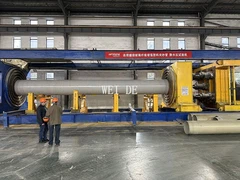
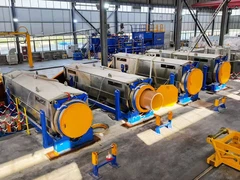
- Centrifugal Casting (Optional): Some jacking pipe production lines incorporate centrifugal casting technology. In centrifugal casting, the mold rotates at high speed, causing the concrete to be evenly distributed along the inner wall of the mold due to centrifugal force. This method can produce pipes with a smooth inner surface and high - density structure. If you are interested in Centrifugal Casting Fiberglass Pipeline Production Line, it also utilizes similar principles to create high - quality pipes.
4. Curing System
Curing is a critical process in jacking pipe production. It allows the concrete to gain strength and durability over time.
- Curing Chambers: Curing chambers are used to provide a controlled environment for the pipes during the curing process. They can maintain a constant temperature and humidity level, which is essential for the proper hydration of the concrete. There are different types of curing chambers, such as steam - curing chambers and water - curing chambers.
- Curing Time and Temperature Control: The curing time and temperature are carefully controlled according to the type of concrete and the specifications of the jacking pipes. Generally, higher temperatures can accelerate the curing process, but they need to be carefully regulated to avoid cracking or other quality issues.
5. Demolding and Finishing System
Once the pipes are fully cured, they are ready to be demolded and finished.
- Demolding Equipment: Demolding equipment is used to remove the pipes from the molds. This process needs to be carried out carefully to avoid damaging the pipes. Hydraulic or mechanical demolding devices are commonly used in jacking pipe production lines.
- Finishing Machines: After demolding, the pipes may require some finishing operations, such as grinding, polishing, and cutting. Finishing machines are used to ensure that the pipes meet the required dimensions and surface quality standards.
6. Quality Control System
Quality control is an integral part of the Jacking Pipe Production Line. It ensures that the final products meet the strict industry standards.
- Non - Destructive Testing Equipment: Non - destructive testing methods, such as ultrasonic testing and X - ray testing, are used to detect internal defects in the pipes without damaging them. These tests can identify cracks, voids, or other structural flaws that may affect the performance of the pipes.
- Dimensional Inspection Equipment: Dimensional inspection equipment, such as calipers, micrometers, and laser measuring devices, are used to measure the diameter, wall thickness, and length of the pipes. This ensures that the pipes meet the specified dimensions.
7. Automation and Control System
In modern Jacking Pipe Production Lines, automation and control systems play a crucial role in improving efficiency and quality.
- PLC (Programmable Logic Controller): A PLC is used to control and coordinate the operation of all components in the production line. It can monitor the status of each device, adjust the process parameters in real - time, and provide alarms in case of any malfunctions.
- Human - Machine Interface (HMI): The HMI allows operators to interact with the production line. They can input production parameters, monitor the production process, and access historical data through the HMI.
In conclusion, a Jacking Pipe Production Line is a complex and integrated system consisting of multiple components. Each component plays a crucial role in the production process, from raw material handling to quality control. As a supplier of Jacking Pipe Production Line, we are committed to providing high - quality, reliable, and efficient production lines to meet the diverse needs of our customers.
If you are in the market for a Jacking Pipe Production Line or have any questions about our products, we encourage you to contact us for a detailed discussion. Our team of experts is ready to assist you in finding the most suitable solution for your production requirements.
References
- Concrete Pipe Association of America (CPAA). "Standards and Guidelines for Concrete Pipe Production."
- American Society for Testing and Materials (ASTM). "ASTM Standards for Pipe Manufacturing."
Send Inquiry