



What are the quality improvement plans in a Type 4 cylinder factory?
Oct 17, 2025
Leave a message
Hey there! I'm a supplier for a Type 4 cylinder factory, and I've been thinking a lot about quality improvement plans lately. In this blog, I'm gonna share some key strategies that can help boost the quality of Type 4 cylinders in the factory.
First off, let's understand what Type 4 cylinders are. These are composite cylinders that are widely used in various industries, like automotive for hydrogen storage and in some industrial applications. They're made with a plastic liner and a carbon fiber composite overwrap, which gives them high strength and light weight.
Raw Material Quality Control
One of the most important aspects of quality improvement is controlling the quality of raw materials. The plastic liner and the carbon fiber used in Type 4 cylinders have a huge impact on the final product's quality.
For the plastic liner, we need to make sure it's made from high - quality polymers. We should work closely with our polymer suppliers to set strict quality standards. This includes things like the density, melting point, and chemical resistance of the plastic. Regular testing of incoming plastic materials can help catch any issues early on.
When it comes to carbon fiber, it's crucial to source it from reliable suppliers. The tensile strength, modulus, and surface finish of the carbon fiber can affect the performance of the cylinder. We can implement a certification process for our carbon fiber suppliers to ensure they meet our quality requirements.
Manufacturing Process Optimization
The manufacturing process of Type 4 cylinders is complex and involves several steps. Each step needs to be optimized to improve quality.
Filament Winding
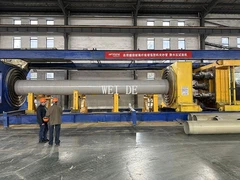
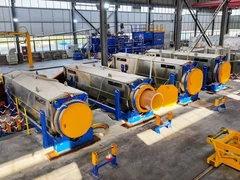
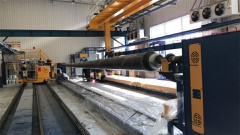
Filament winding is a key process in making Type 4 cylinders. Using advanced Pressure Vessal Winding Machine can significantly improve the winding quality. These machines can precisely control the tension, angle, and pattern of the carbon fiber winding.
We can also implement real - time monitoring during the winding process. Sensors can be installed on the winding machine to detect any irregularities in the winding, such as changes in tension or misalignment of the fiber. If an issue is detected, the machine can automatically adjust or stop the process to prevent defective products.
Resin Infusion
After winding, the carbon fiber needs to be infused with resin. The resin infusion process should be carefully controlled. The viscosity of the resin, the infusion pressure, and the curing time all play important roles in the final quality of the cylinder.
We can conduct experiments to find the optimal resin formulation and infusion parameters. For example, adjusting the resin viscosity can improve the wetting of the carbon fiber, which in turn enhances the bonding between the fiber and the resin.
Quality Assurance and Testing
Quality assurance is an ongoing process that involves testing at different stages of production.
In - process Testing
During the manufacturing process, we should conduct in - process testing. For example, after the plastic liner is formed, we can perform dimensional checks to ensure it meets the design specifications. After the filament winding, non - destructive testing methods like ultrasonic testing can be used to detect any internal defects in the carbon fiber layer.
Final Product Testing
Once the Type 4 cylinders are fully manufactured, they need to undergo a series of final product tests. These include pressure testing, leak testing, and fatigue testing.
Pressure testing is used to ensure that the cylinder can withstand the specified operating pressure without failure. Leak testing checks for any gas or liquid leaks from the cylinder. Fatigue testing simulates the long - term use of the cylinder to evaluate its durability.
Employee Training and Development
Employees are the backbone of any factory. Providing them with proper training and development opportunities can have a big impact on product quality.
We can organize regular training sessions on quality control, new manufacturing techniques, and safety procedures. For example, training employees on how to operate the Pressure Cylinder Winding Machine correctly can reduce the chances of human - error - related defects.
Encouraging employees to participate in continuous improvement initiatives can also be beneficial. They can share their ideas for improving the manufacturing process or quality control methods based on their on - the - ground experience.
Supplier Collaboration
As a supplier, I know how important it is to collaborate closely with the Type 4 cylinder factory. We can work together to develop new materials and manufacturing processes.
For example, we can jointly invest in research and development to find more cost - effective and high - quality raw materials. We can also share technical knowledge and expertise to optimize the manufacturing process.


By having open communication channels, we can quickly address any quality - related issues that arise. If there's a problem with the raw materials I supply, we can work together to find a solution as soon as possible.
Equipment Maintenance and Upgrades
The equipment used in the Type 4 cylinder factory needs to be well - maintained and periodically upgraded.
Regular maintenance of the Type 4 Cylinder Winding Machine and other manufacturing equipment can prevent breakdowns and ensure consistent product quality. This includes things like lubrication, calibration, and replacement of worn - out parts.
Upgrading the equipment can also bring significant improvements in quality. Newer machines often have better precision, automation, and monitoring capabilities. For example, upgrading to a more advanced winding machine can improve the winding accuracy and reduce the defect rate.
Data Analysis for Continuous Improvement
Collecting and analyzing data from the manufacturing process can provide valuable insights for quality improvement.
We can use data analytics tools to track key performance indicators (KPIs) such as the defect rate, production yield, and machine downtime. By analyzing this data, we can identify trends and patterns. For example, if we notice that the defect rate increases during a certain shift, we can investigate the possible causes, such as operator fatigue or equipment issues.
Based on the data analysis, we can develop targeted improvement plans. These plans can be continuously evaluated and adjusted to ensure that the quality of Type 4 cylinders keeps improving over time.
Conclusion
In conclusion, improving the quality of Type 4 cylinders in a factory requires a comprehensive approach. It involves controlling raw material quality, optimizing the manufacturing process, implementing strict quality assurance and testing, training employees, collaborating with suppliers, maintaining and upgrading equipment, and using data analysis for continuous improvement.
If you're in the market for high - quality Type 4 cylinders or related manufacturing equipment, I'd love to have a chat with you. Let's discuss how we can work together to meet your quality and production needs. Feel free to reach out and start a conversation about procurement and how we can make your Type 4 cylinder production even better.
References
- ASME Boiler and Pressure Vessel Code
- ISO standards for composite pressure vessels
- Industry research reports on Type 4 cylinder manufacturing
Send Inquiry