



What is the concentricity control accuracy of an Epoxy Pipe Winding Machine?
Dec 30, 2025
Leave a message
Hey there! As a supplier of Epoxy Pipe Winding Machine, I often get asked about the concentricity control accuracy of these machines. So, I thought I'd take a moment to break it down for you.
First off, let's talk about what concentricity control accuracy means in the context of an epoxy pipe winding machine. Concentricity refers to how well the layers of material are wound around the mandrel to form the pipe. When the concentricity is accurate, the pipe has a uniform wall thickness all the way around. This is super important because it affects the strength, durability, and overall quality of the pipe.
The accuracy of concentricity control in an epoxy pipe winding machine can vary depending on a few factors. One of the main factors is the design and engineering of the machine itself. A well - designed machine will have features that help ensure precise winding. For example, some machines are equipped with advanced servo - motor systems. These motors can control the speed and movement of the winding head with high precision. They can adjust the position of the fiber or resin application in real - time to compensate for any minor variations during the winding process.
Another factor that impacts concentricity control accuracy is the quality of the components used in the machine. High - quality bearings, for instance, can reduce friction and vibration. When there's less vibration, the winding process is more stable, and it's easier to maintain accurate concentricity. Similarly, a well - calibrated tension control system is crucial. If the tension of the fibers being wound is not consistent, it can lead to uneven winding and poor concentricity.
Now, let's get into the numbers. In general, a good epoxy pipe winding machine should be able to achieve a concentricity control accuracy within a very tight tolerance. For most industrial applications, an accuracy of ±0.1 mm to ±0.3 mm is considered excellent. This means that the wall thickness of the pipe will vary by no more than this amount around the circumference.
However, achieving this level of accuracy isn't always a walk in the park. There are some challenges that can affect concentricity control. One of the biggest challenges is the type of material being used. Different fibers and resins have different properties. Some fibers may be more prone to stretching or breaking under tension, which can throw off the winding process. Resins can also have different viscosities, which can affect how they flow and adhere to the fibers during winding.
Temperature and humidity can also play a role. Changes in environmental conditions can cause the materials to expand or contract, which can impact the concentricity of the wound pipe. For example, if the temperature is too high, the resin may cure too quickly, leading to uneven winding. On the other hand, if it's too cold, the resin may not flow properly, resulting in a less - than - perfect pipe.
To overcome these challenges, modern epoxy pipe winding machines are often equipped with sophisticated control systems. These systems can monitor and adjust various parameters during the winding process. For example, they can adjust the tension of the fibers based on the feedback from sensors. They can also compensate for changes in temperature and humidity by adjusting the speed of the winding head or the flow rate of the resin.
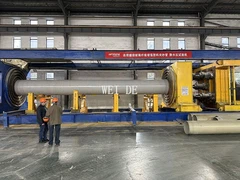
Let's take a look at some of the different types of epoxy pipe winding machines and how their concentricity control accuracy might vary. The Epoxy Horizontal Winding Machine is a popular choice for many applications. These machines are designed to wind pipes horizontally, which can sometimes make it easier to control the concentricity. The horizontal orientation allows for better gravity - assisted resin flow, which can lead to more uniform winding.
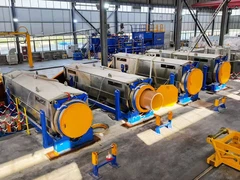
The Epoxy Filament Winding Machine, on the other hand, is specifically designed for filament winding. This process involves winding continuous fibers around a mandrel to create a strong, lightweight pipe. These machines often have very high - precision control systems to ensure accurate concentricity, especially when dealing with high - performance fibers.
So, why is concentricity control accuracy so important? Well, for starters, it directly affects the performance of the pipe. A pipe with poor concentricity may have weak spots where the wall thickness is thinner. These weak spots can lead to premature failure, especially under high - pressure or heavy - load conditions. In industries such as oil and gas, water treatment, and aerospace, where pipes are used in critical applications, having a pipe with accurate concentricity is non - negotiable.
In addition, accurate concentricity control can also improve the efficiency of the manufacturing process. When the pipe has a uniform wall thickness, it requires less post - processing. There's no need to spend extra time and money on grinding or machining to correct unevenness. This can save both time and resources in the long run.


If you're in the market for an epoxy pipe winding machine, concentricity control accuracy should be one of your top considerations. You want a machine that can consistently produce pipes with the highest level of quality. At our company, we understand the importance of this factor. That's why we've invested heavily in research and development to ensure that our machines offer the best possible concentricity control accuracy.
We've worked hard to fine - tune the design and engineering of our machines. We use only the highest - quality components and state - of - the - art control systems. Our team of experts is constantly testing and improving our machines to meet the ever - evolving needs of our customers.
If you're interested in learning more about our epoxy pipe winding machines or discussing your specific requirements, we'd love to hear from you. Whether you're a small - scale manufacturer or a large - scale industrial operation, we can help you find the right machine for your needs. Reach out to us, and let's start a conversation about how we can help you take your pipe manufacturing to the next level.
References
- Industrial Filament Winding Handbook
- Advanced Composites Manufacturing Technologies Journal
Send Inquiry