



What is the role of a programmable logic controller (PLC) in a winding machine?
Sep 25, 2025
Leave a message
As a supplier of winding machines, I've seen firsthand how programmable logic controllers (PLCs) play a pivotal role in these machines. Let's dive into what exactly a PLC does in a winding machine and why it's so important.
First off, what's a PLC? Well, a PLC is like the brain of an industrial machine. It's a specialized computer that can be programmed to control different functions and processes. In a winding machine, it manages a whole bunch of tasks that are crucial for getting the job done right.
One of the main jobs of a PLC in a winding machine is to control the speed. You see, different winding jobs require different speeds. For example, when winding delicate materials, you need a slow and steady speed to avoid any damage. On the other hand, for more robust materials, you can crank up the speed to get the job done faster. The PLC allows us to set and adjust the speed precisely. It can monitor the actual speed of the winding process and make real - time adjustments if there are any deviations. This ensures that the winding is consistent and of high quality.
Another key function is tension control. Tension is super important in winding. If the tension is too high, it can break the material being wound. If it's too low, the winding won't be tight enough, and the finished product might not be stable. The PLC can measure the tension in the material and control the braking or driving systems in the winding machine to maintain the right tension throughout the process. This is especially crucial when winding materials like wires or fibers, where consistent tension is essential for the performance of the final product.
The PLC also manages the number of turns. In many winding applications, you need to wind a specific number of turns to meet the design requirements. The PLC keeps track of the number of rotations and stops the winding process once the desired number of turns is reached. This accuracy is vital in industries such as electronics, where the number of turns in a coil can affect its electrical properties.
Now, let's talk about the automation aspect. With a PLC, we can automate the entire winding process. We can program the machine to start and stop at specific times, change the speed or tension based on pre - set parameters, and even perform different winding patterns. This not only saves time but also reduces the chances of human error. For example, in a mass - production setting, the PLC can ensure that each winding is identical, which is crucial for maintaining product consistency.
In addition to these basic functions, a PLC in a winding machine can also handle more complex tasks. For instance, it can communicate with other devices in the production line. If the winding machine is part of a larger manufacturing process, the PLC can exchange data with other machines, such as a cutting machine or a packaging machine. This integration allows for a more seamless and efficient production process.
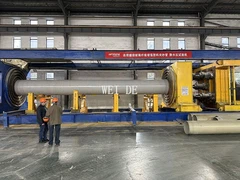
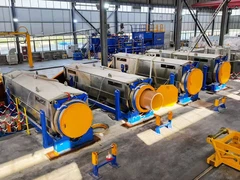
Let's take a look at some of the winding machines we offer. We have the Epoxy Filament Winding Machine, which is designed for winding epoxy filaments. The PLC in this machine is programmed to handle the unique properties of epoxy filaments, such as their sensitivity to temperature and tension. It ensures that the winding process is smooth and that the final product has the right characteristics.
Our Epoxy Horizontal Winding Machine is another great example. This machine is used for horizontal winding of epoxy materials. The PLC in this machine is optimized for horizontal winding operations, controlling the speed, tension, and number of turns to produce high - quality epoxy windings.
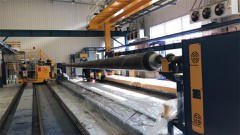
We also have the High - pressure Petroleum Pipeline Production Line. In this production line, the winding machines are equipped with PLCs that can handle the large - scale and high - precision winding required for high - pressure petroleum pipelines. The PLCs ensure that the pipelines are wound with the right amount of material and at the correct tension to withstand high pressures.
In conclusion, the role of a PLC in a winding machine is multi - faceted and essential. It controls speed, tension, and the number of turns, automates the process, and enables communication with other devices. This results in high - quality, consistent, and efficient winding operations.
If you're in the market for a winding machine and want to learn more about how our machines with advanced PLC technology can meet your needs, feel free to reach out. We're always happy to discuss your specific requirements and provide solutions that fit your business.
References


- Industrial Automation Handbook
- Winding Machine Technology Manuals
Send Inquiry