



What materials are used in a centrifigua casting grp pipe machine?
Oct 28, 2025
Leave a message
Hey there! As a supplier of centrifigua casting GRP pipe machines, I often get asked about the materials used in these machines. So, I thought I'd write this blog to share all the details with you.
First off, let's understand what a centrifigua casting GRP pipe machine does. It's used to produce Glass Reinforced Plastic (GRP) pipes through a centrifugal casting process. This process involves rotating a mold at high speeds while resin and other materials are added, which results in a strong and durable pipe.
Resin
One of the key materials used in a centrifigua casting GRP pipe machine is resin. Resin acts as the matrix that holds everything together in the GRP pipe. There are different types of resins available, but the most commonly used ones in this process are polyester resin and epoxy resin.
Polyester resin is popular because it's relatively inexpensive and easy to work with. It has good chemical resistance and mechanical properties, making it suitable for a wide range of applications. Epoxy resin, on the other hand, offers even better mechanical strength and chemical resistance. It's often used in more demanding applications where high performance is required.
Fiberglass
Fiberglass is another crucial material. It provides the reinforcement in the GRP pipes, giving them their strength and stiffness. Fiberglass comes in different forms, such as chopped strands and continuous filaments.
Chopped strands are short pieces of fiberglass that are randomly distributed in the resin. They're easy to handle and can be quickly added to the resin during the casting process. Continuous filaments, on the other hand, are long strands of fiberglass that are wound around the mold in a specific pattern. This creates a more organized and stronger reinforcement structure in the pipe.
Fillers
Fillers are also used in the centrifigua casting process. They're added to the resin to reduce costs, improve certain properties, or both. Common fillers include calcium carbonate, silica sand, and talc.
Calcium carbonate is a widely used filler because it's inexpensive and can improve the pipe's stiffness and dimensional stability. Silica sand can enhance the pipe's abrasion resistance, making it suitable for applications where the pipe may be exposed to rough surfaces or abrasive materials. Talc can improve the pipe's surface finish and reduce shrinkage during the curing process.
Pigments
Pigments are used to give the GRP pipes their color. They can be added to the resin to create pipes in different colors, which can be useful for identification or aesthetic purposes. Pigments need to be carefully selected to ensure they're compatible with the resin and don't affect the pipe's performance.
Release Agents
Release agents are essential for the smooth operation of the centrifigua casting GRP pipe machine. They're applied to the inside of the mold before the casting process to prevent the GRP pipe from sticking to the mold. There are different types of release agents available, such as wax-based and silicone-based release agents.
The Role of These Materials in the Production Line
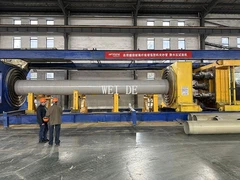
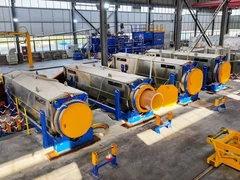
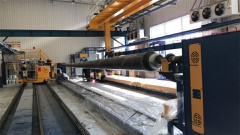
Now that we've talked about the individual materials, let's see how they all come together in the production line. The Centrifugal Casting Fiberglass Pipeline Production Line is where the magic happens.
First, the mold is prepared by applying a release agent. Then, the resin is mixed with the fillers, pigments, and any other additives. The chopped fiberglass strands or continuous filaments are added to the resin mixture, depending on the desired properties of the pipe.
The mixture is then poured into the rotating mold. As the mold spins at high speeds, the centrifugal force distributes the mixture evenly along the inner surface of the mold. This creates a uniform layer of GRP material, which gradually cures to form the pipe.
Once the pipe is cured, it's removed from the mold. It may then undergo some finishing processes, such as trimming and surface treatment, before it's ready for use.
Applications of GRP Pipes
GRP pipes produced by centrifigua casting machines have a wide range of applications. They're commonly used in the water and wastewater industry for transporting water, sewage, and other fluids. Their corrosion resistance makes them ideal for these applications, as they can withstand the harsh chemicals and environments found in water treatment plants and sewer systems.
GRP pipes are also used in the oil and gas industry for transporting oil, gas, and other hydrocarbons. Their high strength and lightweight properties make them easy to install and transport, even in remote or difficult-to-reach locations.
In addition, GRP pipes are used in the construction industry for various purposes, such as ventilation systems, drainage pipes, and structural components. Their versatility and durability make them a popular choice for many construction projects.
Why Choose Our Centrifigua Casting GRP Pipe Machine
As a supplier, we offer high-quality centrifigua casting GRP pipe machines that are designed to produce pipes with excellent properties. Our machines are equipped with advanced technology and features to ensure efficient and reliable operation.
We also provide comprehensive after-sales service and support to our customers. Whether you need help with installation, maintenance, or troubleshooting, our team of experts is always ready to assist you.
If you're interested in our Jacking Pipe Production Line or any other products, feel free to get in touch with us. We're more than happy to discuss your requirements and provide you with a customized solution.
Conclusion
In conclusion, the materials used in a centrifigua casting GRP pipe machine play a crucial role in determining the properties and performance of the pipes. Resin, fiberglass, fillers, pigments, and release agents all work together to create strong, durable, and corrosion-resistant GRP pipes.
If you're in the market for a centrifigua casting GRP pipe machine or are looking to upgrade your existing production line, don't hesitate to contact us. We're here to help you take your GRP pipe production to the next level.


References
- "Handbook of Fiberglass and Advanced Composite Materials" by Nicholas P. Cheremisinoff
- "Composites Manufacturing: Materials, Product, and Process Engineering" by F. F. Wang and S. S. Wang
Send Inquiry