






Are Type 4 cylinders affected by humidity?
Sep 10, 2025
Leave a message
Hey there! I'm a supplier of Type 4 cylinders, and today I wanna dig into a question that often pops up: Are Type 4 cylinders affected by humidity?
First off, let's get a quick lowdown on what Type 4 cylinders are. These bad boys are composite cylinders with a plastic liner and a carbon fiber overwrap. They're super popular because they're lightweight, corrosion - resistant, and can handle high pressures. You'll find them in all sorts of applications, from storing compressed natural gas (CNG) in vehicles to holding breathing air for scuba divers.
Now, humidity. It's that invisible stuff in the air that can range from bone - dry to so sticky you feel like you're swimming through it. Humidity is basically the amount of water vapor in the air, and it can have a big impact on all kinds of materials and products.
So, how does humidity affect Type 4 cylinders? Well, the plastic liner is the first thing to consider. Most plastic liners used in Type 4 cylinders are made from materials like high - density polyethylene (HDPE). These plastics can absorb water to some extent. When they do, it can cause a few issues.
One problem is dimensional changes. When the plastic liner absorbs water, it can swell. This might not seem like a big deal at first, but over time, it can put extra stress on the carbon fiber overwrap. The carbon fiber is designed to work in harmony with the liner, and any changes in the liner's size can disrupt that balance. If the stress gets too high, it could potentially lead to cracks or delamination in the carbon fiber layer.
Another concern is the impact on the mechanical properties of the plastic. Water absorption can make the plastic softer and less stiff. This means that the liner might not be able to withstand the same amount of pressure as it could when it was dry. In extreme cases, this could compromise the overall integrity of the cylinder and make it unsafe to use.
But it's not just the liner that can be affected. The carbon fiber overwrap can also face some challenges due to humidity. Carbon fiber itself doesn't absorb water easily, but the resin that holds the fibers together can. The resin is usually an epoxy - based material. When it absorbs water, it can undergo a process called hydrolysis. This breaks down the chemical bonds in the resin, weakening its ability to hold the carbon fibers in place. As a result, the strength and stiffness of the overwrap can decrease, which again affects the cylinder's performance.
Now, it's not all doom and gloom. The manufacturers of Type 4 cylinders are well aware of these potential issues, and they take steps to mitigate them. For example, they use special coatings on the plastic liner to reduce water absorption. These coatings act as a barrier, preventing water from getting into the plastic. Similarly, the resin used in the carbon fiber overwrap is often formulated to be more resistant to hydrolysis.
However, even with these precautions, it's still important to be aware of the conditions in which the cylinders are stored and used. If the humidity is extremely high for long periods, it can still have an impact. For instance, in coastal areas where the air is often humid and salty, the cylinders need to be inspected more frequently. The salt in the air can also accelerate the corrosion process if there are any small imperfections in the cylinder's protective layers.
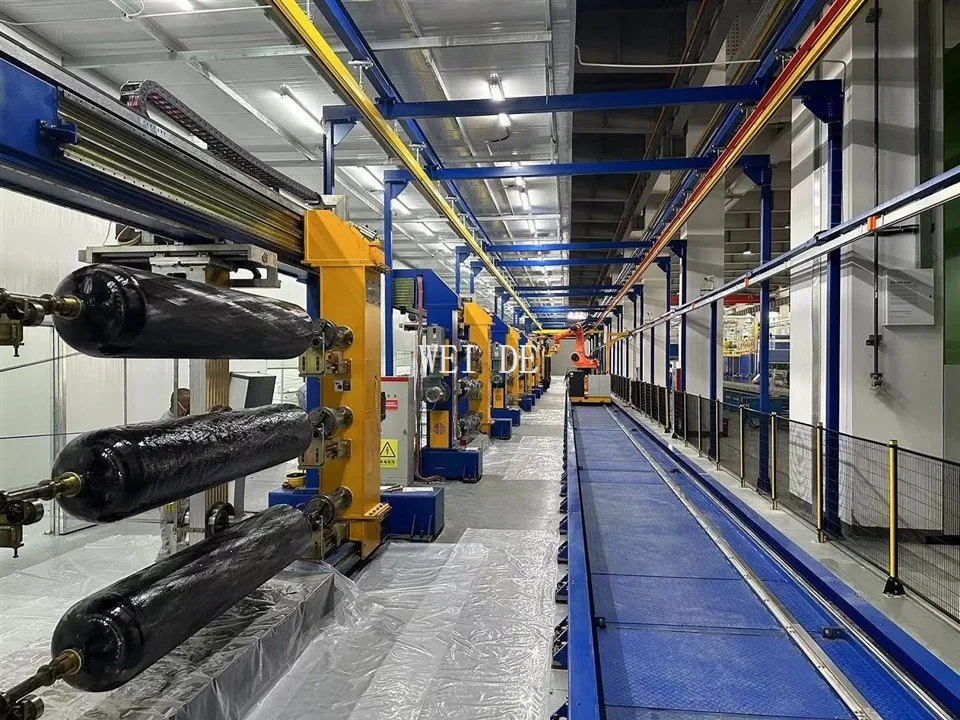
When it comes to manufacturing Type 4 cylinders, the humidity during the production process is also crucial. If the humidity is too high when the carbon fiber is being wound around the liner, it can affect the bonding between the resin and the fibers. This is where machines like the Type 3 Cylinder Winding Machine and Pressure Cylinder Winding Machine come into play. These machines are designed to create a controlled environment where the winding process can be carried out with precision, minimizing the impact of external factors like humidity.
The Pressure Vessal Winding Machine is another important piece of equipment. It ensures that the cylinders are wound evenly and that the resin is applied correctly. By maintaining the right humidity levels during the manufacturing process, we can produce high - quality Type 4 cylinders that are more resistant to the effects of humidity in the long run.
So, what can you do as a user or a buyer of Type 4 cylinders? First of all, make sure you store the cylinders in a dry environment. If possible, keep them in a climate - controlled area where the humidity can be regulated. Regular inspections are also essential. Look for any signs of swelling, discoloration, or damage on the cylinder. If you notice anything unusual, it's best to have the cylinder checked by a professional.
As a supplier, I understand the importance of providing high - quality Type 4 cylinders that can withstand different environmental conditions. We invest in the latest technology and manufacturing processes to ensure that our cylinders are as resistant to humidity as possible. But we also know that proper care and maintenance from the users are key to the long - term performance of the cylinders.
If you're in the market for Type 4 cylinders, whether it's for a small - scale project or a large - scale industrial application, I'd love to have a chat with you. We can discuss your specific needs and how our cylinders can meet them. Contact us to start the conversation and let's find the perfect solution for your requirements.

References
- "Composite Pressure Vessels: Design, Analysis, and Manufacturing" by John W. Gillespie Jr.
- "Handbook of Plastics, Elastomers, and Composites" by Charles A. Harper
Send Inquiry