



Can a marine fiberglass pipeline production line be used for other composite material production?
Sep 09, 2025
Leave a message
Hey there! I'm a supplier of Marine Fiberglass Pipeline Production Line. Over the years, I've gotten a bunch of questions from customers about whether our production line can be used for other composite material production. So, I thought I'd sit down and write this blog to share my thoughts on the matter.
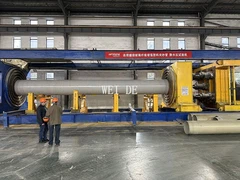
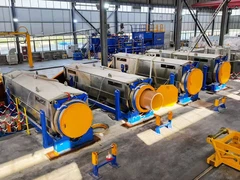
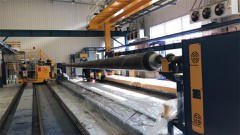
First off, let's talk a bit about what a marine fiberglass pipeline production line actually does. This type of production line is designed to manufacture fiberglass pipelines that are used in marine environments. Fiberglass is a great material for these pipelines because it's corrosion-resistant, lightweight, and has high strength. The production process usually involves winding fiberglass strands around a mandrel using a machine, like the Epoxy Horizontal Winding Machine, and then applying a resin to bind the fibers together.
Now, the big question: Can this production line be used for other composite material production? The short answer is yes, it can. But there are a few things to consider.
Similarities in Composite Material Production
One of the reasons a marine fiberglass pipeline production line can be adapted for other composite materials is that the basic principles of composite manufacturing are similar across different materials. Whether you're working with fiberglass, carbon fiber, or aramid fiber, the general idea is to combine a reinforcement material (the fibers) with a matrix material (usually a resin) to create a composite with enhanced properties.
For example, the winding process used in fiberglass pipeline production can also be applied to other composite products. If you want to make carbon fiber tubes or aramid fiber rods, you can use the same winding technique. The Epoxy Horizontal Winding Machine on our production line can be adjusted to handle different types of fibers and resins. You just need to change the settings for things like winding speed, tension, and the amount of resin being applied.


Another similarity is the curing process. After the fibers are wound and the resin is applied, the composite needs to be cured to harden it. Most composite materials require some form of curing, whether it's through heat, chemical reactions, or a combination of both. Our production line has the equipment and controls in place to manage the curing process, which can be adapted for different composite materials.
Differences and Adaptations
Of course, there are also some differences between marine fiberglass pipeline production and other composite material production that need to be addressed.
Material Properties
Different composite materials have different properties. For example, carbon fiber is much stronger and stiffer than fiberglass, but it's also more expensive. Aramid fiber has high tensile strength and is very resistant to impact, but it can be more difficult to work with. These differences mean that you may need to make some adjustments to the production process.
When working with carbon fiber, for instance, you might need to use a different type of resin that is specifically formulated for carbon fiber composites. The winding tension may also need to be adjusted to prevent the carbon fibers from breaking. Our production line can be modified to accommodate these changes. We can provide guidance on the best resin systems and process parameters for different composite materials.
Product Design
The design of the final product also plays a role. Marine fiberglass pipelines are typically long, cylindrical structures. If you want to produce other composite products, such as flat panels or complex-shaped parts, you'll need to make some changes to the tooling and the production process.
For flat panel production, you may need to use a different type of winding pattern or a different type of mold. Our team can help you design and develop the appropriate tooling for your specific product requirements. We have experience in customizing production lines for a variety of composite products.
Applications for Other Composite Materials
There are many potential applications for using a marine fiberglass pipeline production line to produce other composite materials.
High - Pressure Petroleum Pipelines
One example is the production of High - pressure Petroleum Pipeline Production Line. Composite materials are increasingly being used in the oil and gas industry to replace traditional steel pipelines. They offer advantages such as corrosion resistance, reduced weight, and lower installation costs.
Our production line can be used to manufacture high - pressure petroleum pipelines made from composite materials like carbon fiber or fiberglass - carbon fiber hybrids. The winding and curing processes can be optimized to meet the strict requirements of the oil and gas industry, such as high pressure and temperature resistance.
Aerospace and Automotive Components
Composite materials are also widely used in the aerospace and automotive industries. Our production line can be adapted to produce components such as aircraft wings, automotive body panels, and drive shafts. These applications require high - quality composite materials with precise mechanical properties.
By making the necessary adjustments to the production process, we can ensure that the composite components meet the strict standards of these industries. We can work with you to develop custom solutions for your aerospace or automotive projects.
Contact Us for More Information
If you're interested in using our Marine Fiberglass Pipeline Production Line for other composite material production, we'd love to hear from you. Our team of experts has the knowledge and experience to help you make the transition. We can provide a detailed analysis of your requirements, offer customized solutions, and support you throughout the production process.
Whether you're a small startup looking to enter the composite materials market or a large corporation looking to expand your product line, we're here to help. Just reach out to us, and we'll start the conversation about how our production line can be adapted for your specific needs.
References
- “Composite Materials Handbook,” published by various industry associations.
- Technical papers on composite manufacturing processes from academic journals.
- Industry reports on the use of composite materials in different sectors.
Send Inquiry