



Can a large winding machine wind with different winding densities in multiple operations?
Sep 09, 2025
Leave a message
Hey there! As a supplier of large winding machines, I often get asked some pretty interesting questions from my customers. One question that comes up quite a bit is, "Can a large winding machine wind with different winding densities in multiple operations?" Well, let's dig into this topic and find out.


First off, let's talk about what winding density is. Winding density refers to how closely the material is wound around a core or a mandrel. It's a crucial factor because it can affect the strength, durability, and overall performance of the final product. For example, in the production of pipes or composite materials, different winding densities can be used to achieve specific mechanical properties.
Now, back to the main question: Can a large winding machine handle different winding densities in multiple operations? The short answer is yes, and here's why.
Modern large winding machines are equipped with advanced control systems. These systems allow operators to precisely adjust the speed, tension, and path of the winding material. By tweaking these parameters, it's possible to change the winding density during different stages of the winding process. For instance, you might start with a lower winding density to create a base layer that provides flexibility, and then increase the density in subsequent layers to enhance the strength of the product.
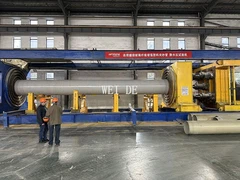
Let's take a look at some real - world applications. If you're in the business of manufacturing continuous fiberglass pipes, a Continuous Fiberglass Pipe Winding Machine can be programmed to wind with different densities. In the initial layers, a looser winding might be used to accommodate any potential expansion or contraction of the pipe during use. As the winding progresses, a higher density can be applied to meet the required pressure - bearing capacity.
Similarly, Composite Material Winding Equipment can also benefit from the ability to vary winding densities. Composites are often used in aerospace, automotive, and marine industries, where different parts of a component may require different mechanical properties. By adjusting the winding density, manufacturers can optimize the performance of these composite parts.
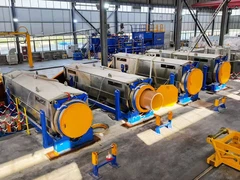
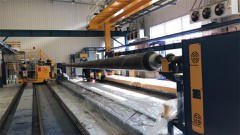
Another example is the Continue Filament Winding FRP Pipe Produciton Line. This production line can handle multiple winding operations with different densities. The first few layers might be wound at a lower density to ensure good adhesion between the resin and the fibers, while the outer layers can be wound more tightly to protect the pipe from external damage.
But how does a large winding machine actually achieve this? Well, the key lies in the software that controls the machine. The software allows operators to create detailed winding programs. These programs can specify the exact winding density for each layer, as well as the number of turns, the angle of winding, and other important parameters. Once the program is set up, the machine can execute the winding operations automatically, ensuring consistent and accurate results.
In addition to the software, the mechanical design of the winding machine also plays a role. High - quality large winding machines are built with precision components that can handle the changes in tension and speed required for different winding densities. The guides and rollers are designed to ensure smooth movement of the winding material, even when the density changes.
Of course, there are some challenges associated with winding with different densities in multiple operations. One of the main challenges is maintaining the quality of the winding. If the tension is not properly adjusted, it can lead to uneven winding, which may affect the performance of the final product. To overcome this, operators need to have a good understanding of the material being wound and the capabilities of the machine. Regular maintenance and calibration of the machine are also essential to ensure accurate and consistent winding.
Another challenge is the time required for programming and setup. Creating a winding program for multiple operations with different densities can be a complex task. It requires careful planning and testing to ensure that the program works as intended. However, once the program is set up, the machine can run efficiently, producing high - quality products with different winding densities.
So, if you're in the market for a large winding machine that can handle different winding densities in multiple operations, you're in luck. Our large winding machines are designed to meet these requirements. They offer advanced control systems, precision mechanical components, and user - friendly software that make it easy to achieve the desired winding densities.
Whether you're manufacturing fiberglass pipes, composite materials, or other products, our machines can help you optimize your production process. By being able to wind with different densities, you can create products that are tailored to the specific needs of your customers.
If you're interested in learning more about our large winding machines or have any questions about winding with different densities, don't hesitate to reach out. We're here to help you make the most of your winding operations. Contact us today to start a discussion about how our machines can fit into your production line and help you take your business to the next level.
References
- Industry reports on winding machine technology
- Technical manuals of large winding machines
- Case studies on the application of different winding densities in product manufacturing
Send Inquiry