



Can 'Countinue winding' be automated?
Sep 05, 2025
Leave a message
As a supplier of continue winding equipment, I've been getting a lot of questions lately about whether "continue winding" can be automated. It's a hot topic in our industry, and I'm excited to share my thoughts on it.
First off, let's talk about what continue winding is. Continue winding is a process used to manufacture products like pipes, tanks, and other cylindrical structures. It involves winding continuous fibers, such as fiberglass, around a rotating mandrel in a precise pattern. This process creates a strong, durable product with excellent mechanical properties.
Now, the big question: Can continue winding be automated? The short answer is yes, it can. In fact, automation in continue winding has come a long way in recent years, and it offers several significant advantages.
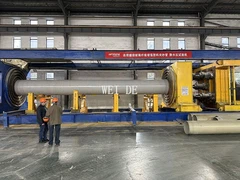
One of the main benefits of automating continue winding is increased efficiency. Automated machines can work around the clock without getting tired or making mistakes due to fatigue. They can also wind the fibers at a consistent speed and tension, which results in a more uniform product. This means less waste and higher production rates. For example, our CFW Continuous Pipe Winding Machine is designed with advanced automation features that allow it to produce high - quality pipes at a much faster pace than traditional manual methods.
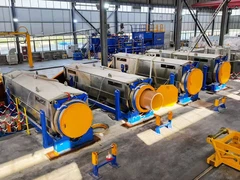
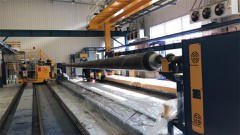
Another advantage is improved quality control. Automated systems can monitor and adjust the winding process in real - time. They can detect any deviations from the set parameters, such as fiber tension or winding angle, and make immediate corrections. This ensures that every product meets the strict quality standards. Our Continue Filament Winding FRP Pipe Produciton Line is equipped with sensors and control systems that constantly monitor the winding process, guaranteeing the quality of the FRP pipes.
Automation also reduces labor costs. Manual continue winding is a labor - intensive process that requires skilled workers. By automating the process, companies can reduce their dependence on manual labor, which can be expensive and hard to find in some regions. Instead, a few operators can oversee multiple automated machines, increasing productivity and reducing overall costs.
However, automating continue winding isn't without its challenges. One of the main obstacles is the initial investment. Automated machines are more expensive to purchase and install than manual equipment. There's also the cost of training employees to operate and maintain these complex systems. But in the long run, the savings in labor and increased production can offset these initial costs.
Another challenge is the need for flexibility. Different products may require different winding patterns, fiber types, and mandrel sizes. An automated system needs to be able to adapt to these changes quickly and easily. Our engineers are constantly working on improving the flexibility of our Continuous Fiberglass Pipe Winding Machine to handle a wide range of production requirements.
When it comes to the technology behind automated continue winding, there are several key components. The control system is the brain of the operation. It manages the speed of the mandrel rotation, the movement of the fiber delivery system, and the tension of the fibers. Advanced control systems use programmable logic controllers (PLCs) and human - machine interfaces (HMIs) to allow operators to set and adjust the parameters easily.
The fiber delivery system is also crucial. It needs to feed the fibers onto the mandrel accurately and consistently. Some automated systems use robotic arms to place the fibers precisely, while others use specialized guides and rollers.


In addition, sensors play a vital role in automated continue winding. They can measure parameters such as fiber tension, winding angle, and the thickness of the wound layers. This data is then used by the control system to make adjustments and ensure the quality of the product.
As a supplier, we've seen a growing demand for automated continue winding solutions. More and more companies are realizing the benefits of automation and are looking for reliable equipment and support. We're committed to providing our customers with the latest technology and the best - in - class service.
If you're in the market for continue winding equipment and are considering automation, we'd love to have a chat with you. Whether you're a small - scale manufacturer looking to increase your production or a large - scale operation aiming to improve quality control, we have the solutions to meet your needs. Contact us to discuss your specific requirements and let's explore how our automated continue winding equipment can take your business to the next level.
In conclusion, "continue winding" can definitely be automated, and it offers many benefits in terms of efficiency, quality control, and cost savings. While there are challenges to overcome, the technology is constantly evolving, making automated continue winding more accessible and effective than ever before.
References:
- Industry reports on continue winding technology
- Technical specifications of our continue winding machines
Send Inquiry