



What are the main components of a Pressure Vessal Winding Machine?
Sep 08, 2025
Leave a message
Hey there! As a supplier of Pressure Vessal Winding Machines, I'm super excited to dive into the main components of these amazing pieces of equipment. So, let's get right into it!
1. Filament Delivery System
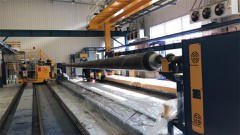
The filament delivery system is like the heart of a Pressure Vessal Winding Machine. It's responsible for getting the filament – usually fiberglass, carbon fiber, or aramid fiber – from the spools to the winding area in a smooth and controlled way.
We've got these spool holders that keep the filament spools in place. They're designed to let the spools rotate freely, so the filament can unwind without any hitches. And there are tension control devices too. These bad boys make sure the filament has the right amount of tension as it's being fed. If the tension's too low, the winding won't be tight enough. Too high, and you might break the filament.


The guides are another crucial part of this system. They direct the filament from the spools to the mandrel, which is where the pressure vessel is actually being formed. They keep the filament on the right path, ensuring a precise winding pattern. Some of our Pressure Vessal Winding Machines come with adjustable guides, so you can customize the winding layout depending on your specific needs.
2. Mandrel Rotation System
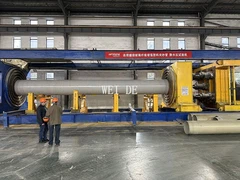
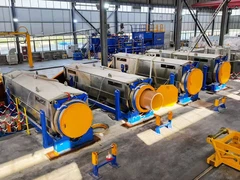
The mandrel rotation system is all about making the mandrel spin. The mandrel is a shaped core around which the filament is wound to create the pressure vessel. It can be made of different materials like metal or composite, depending on the application.
We use high - quality motors to drive the mandrel. These motors are super powerful and can provide a smooth and consistent rotation speed. The speed control is really important because it affects the quality of the winding. If the mandrel rotates too fast, the filament might not lay down properly. Too slow, and the production process will be way too long.
There are also bearings and shafts that support the mandrel. They need to be really durable and precise to ensure that the mandrel rotates without any wobbling. A wobbly mandrel can lead to uneven winding, which can weaken the pressure vessel. Our machines are designed with top - notch bearings and shafts to guarantee a stable rotation.
3. Traverse System
The traverse system is what moves the filament back and forth along the length of the mandrel. This is how we create different winding patterns, like helical or hoop windings.
It consists of a carriage that holds the filament delivery system. The carriage moves along a rail, guided by a lead screw or a linear actuator. The speed and the range of the carriage movement are adjustable, so you can create all sorts of winding patterns.
For example, in a hoop winding, the carriage moves quickly back and forth over a short distance to create a tight circular pattern around the mandrel. In a helical winding, the carriage moves more slowly and covers a longer distance while the mandrel rotates, creating a spiral pattern. Our Type 3 Cylinder Winding Machine and Type 4 Cylinder Winding Machine are equipped with advanced traverse systems that can handle complex winding patterns with ease.
4. Resin Bath (if applicable)
In some cases, the filament needs to be coated with resin before it's wound onto the mandrel. That's where the resin bath comes in.
The resin bath is a container filled with resin. The filament passes through the bath, getting coated with the resin as it goes. The resin acts as a binder, holding the filaments together and giving the pressure vessel its strength.
We have to control the temperature and viscosity of the resin in the bath. If the temperature's too low, the resin might be too thick and won't coat the filament evenly. Too high, and the resin might start to cure too quickly. There are also pumps and agitators in the resin bath to keep the resin well - mixed and flowing smoothly.
5. Control System
The control system is like the brain of the Pressure Vessal Winding Machine. It manages all the other components, making sure they work together in harmony.
We use a programmable logic controller (PLC) to control the machine. The PLC allows us to set all the parameters, like the rotation speed of the mandrel, the movement speed of the traverse system, and the tension of the filament. You can program different winding sequences and patterns into the PLC, so you can easily switch between different production runs.
There's also a human - machine interface (HMI), which is basically a touchscreen or a control panel. It lets the operator interact with the machine, monitor the production process, and make any necessary adjustments. The HMI shows real - time data, like the current speed, the number of windings, and any error messages.
6. Safety System
Safety is always a top priority when it comes to operating a Pressure Vessal Winding Machine. That's why we've included a comprehensive safety system.
There are emergency stop buttons located at convenient positions around the machine. If something goes wrong, the operator can quickly press the emergency stop button to halt the machine.
We also have safety guards around the moving parts, like the mandrel and the traverse system. These guards prevent operators from accidentally getting caught in the machinery. There are sensors too, which can detect if the guards are opened during operation and automatically stop the machine to prevent any accidents.
Why Choose Our Pressure Vessal Winding Machines?
Our machines are built with high - quality components, which means they're reliable and long - lasting. We've spent years perfecting the design and functionality of our machines, so you can be sure you're getting a top - of - the - line product.
Whether you're looking for a Type 3 Cylinder Winding Machine, a Type 4 Cylinder Winding Machine, or a general Pressure Vessal Winding Machine, we've got you covered. Our machines are customizable, so you can tailor them to your specific production requirements.
If you're in the market for a Pressure Vessal Winding Machine, don't hesitate to reach out. We'd love to have a chat with you about your needs and see how our machines can help you improve your production process. Whether you're a small - scale manufacturer or a large - scale industrial company, we can provide the right solution for you. So, let's start a conversation and take your business to the next level!
References
- Industry standards and guidelines for pressure vessel winding machines
- Technical documentation from component manufacturers
- In - house research and development reports on machine design and performance
Send Inquiry