



What is the control system of a four axis filament winding machine?
Sep 12, 2025
Leave a message
Hey there! I'm here to talk about the control system of a four-axis filament winding machine. As a supplier of these machines, I've got a ton of hands-on experience with them, and I'm super excited to share what I know.


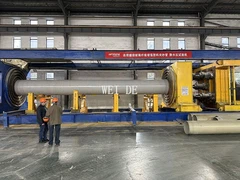
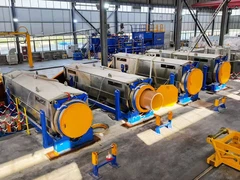
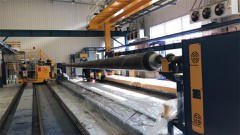
So, what exactly is a four-axis filament winding machine? Well, it's a piece of equipment used to wind continuous fibers, like carbon or glass fibers, around a rotating mandrel in a precise pattern. This process is crucial for manufacturing high-strength composite products, such as Pressure Vessal Winding Machine, Pressure Cylinder Winding Machine, and Type 4 Cylinder Winding Machine. These products are widely used in aerospace, automotive, and energy industries, among others.
Now, let's dive into the control system. The control system of a four-axis filament winding machine is like the brain of the operation. It's responsible for managing all the movements and functions of the machine to ensure that the winding process is accurate, efficient, and consistent.
The Four Axes
First off, let's understand the four axes. The four axes typically include the mandrel rotation axis, the carriage traverse axis, the fiber guide axis, and sometimes an additional axis for special applications.
- Mandrel Rotation Axis: This axis controls the rotation of the mandrel. The speed and direction of the mandrel rotation are crucial because they determine how the fibers are laid down on the mandrel. For example, if you're winding a pressure vessel, the mandrel needs to rotate at a specific speed to ensure that the fibers are evenly distributed and that the winding pattern is correct.
- Carriage Traverse Axis: The carriage traverse axis moves the fiber delivery system along the length of the mandrel. This movement is coordinated with the mandrel rotation to create the desired winding pattern. The speed and acceleration of the carriage traverse need to be carefully controlled to avoid any slack or tension issues in the fibers.
- Fiber Guide Axis: The fiber guide axis is used to control the position of the fiber guide. This axis allows for precise positioning of the fibers on the mandrel, which is essential for creating complex winding patterns. The fiber guide can be adjusted to change the angle and position of the fibers as they are wound onto the mandrel.
Control System Components
The control system of a four-axis filament winding machine consists of several key components:
- Controller: The controller is the heart of the control system. It's usually a programmable logic controller (PLC) or a computer numerical control (CNC) system. The controller receives input from various sensors and user interfaces and sends out commands to the motors and actuators that control the four axes.
- Sensors: Sensors play a vital role in the control system. They are used to measure various parameters, such as the position, speed, and tension of the mandrel, carriage, and fibers. For example, an encoder can be used to measure the rotation speed of the mandrel, while a tension sensor can be used to monitor the tension of the fibers. The data from these sensors is fed back to the controller, which then adjusts the machine's operation accordingly.
- Motors and Actuators: Motors and actuators are responsible for converting electrical signals from the controller into mechanical motion. Servo motors are commonly used in four-axis filament winding machines because they offer high precision and control. These motors can be controlled to move the mandrel, carriage, and fiber guide with great accuracy.
- User Interface: The user interface allows operators to interact with the control system. It can be a touchscreen panel or a computer terminal. Through the user interface, operators can input winding parameters, such as the winding pattern, speed, and tension. They can also monitor the machine's operation in real-time and make adjustments as needed.
Winding Pattern Programming
One of the most important functions of the control system is the ability to program winding patterns. Different products require different winding patterns to achieve the desired strength and performance. The control system allows operators to create and store these patterns in its memory.
The programming process usually involves defining the path of the fibers on the mandrel. This can be done using specialized software that allows operators to draw the winding pattern on a computer screen. The software then converts the pattern into a set of instructions that the controller can understand. Once the pattern is programmed, the control system can execute it automatically, ensuring that the same pattern is repeated accurately for each product.
Advantages of a Good Control System
A well-designed control system offers several advantages:
- Accuracy: The control system ensures that the winding process is highly accurate. This results in products with consistent quality and performance. By precisely controlling the four axes, the fibers are laid down in the exact pattern and position, which is crucial for the strength and integrity of the composite product.
- Efficiency: With a good control system, the machine can operate at optimal speeds and with minimal downtime. The control system can automatically adjust the parameters based on the feedback from the sensors, which helps to reduce waste and increase productivity.
- Flexibility: The control system allows for easy customization of winding patterns. This means that the machine can be used to produce a wide variety of products with different shapes and sizes. Operators can quickly change the winding pattern by simply loading a new program into the control system.
Maintenance and Troubleshooting
Like any complex piece of equipment, the control system of a four-axis filament winding machine requires regular maintenance and troubleshooting.
- Maintenance: Regular maintenance includes checking the sensors, motors, and actuators for proper operation. The controller should also be checked for any software updates or malfunctions. Cleaning and lubricating the mechanical components of the machine can also help to ensure smooth operation.
- Troubleshooting: When a problem occurs, the control system can provide diagnostic information to help identify the issue. For example, if there is a problem with the fiber tension, the tension sensor will send an alarm signal to the controller, which can then display the error message on the user interface. Operators can then use this information to troubleshoot and fix the problem.
Conclusion
In conclusion, the control system of a four-axis filament winding machine is a complex but essential part of the manufacturing process. It plays a crucial role in ensuring the accuracy, efficiency, and flexibility of the winding process. As a supplier of four-axis filament winding machines, we understand the importance of a reliable control system, and we strive to provide our customers with the best-in-class technology.
If you're in the market for a four-axis filament winding machine or have any questions about the control system, don't hesitate to reach out. We're here to help you find the right solution for your manufacturing needs. Whether you're looking to produce pressure vessels, cylinders, or other composite products, our machines and control systems can provide you with the performance and quality you're looking for. Let's have a chat and see how we can work together to take your manufacturing to the next level.
References
- "Filament Winding Technology" by J. Summerscales
- "Composite Materials: Design and Applications" by S. Tsai and H. Hahn
Send Inquiry