



What materials can be used in the Jacking Pipe Production Line?
Sep 15, 2025
Leave a message
Hey there! As a supplier of the Jacking Pipe Production Line, I've been getting a lot of questions lately about what materials can be used in this production line. So, I thought I'd put together this blog post to share some insights on the topic.
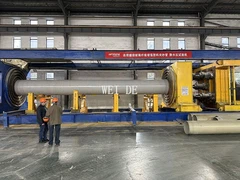
First off, let's talk a bit about what a Jacking Pipe Production Line is. It's a specialized setup that's used to manufacture pipes that are designed for jacking operations. These pipes are typically used in underground construction projects, like laying sewer lines, water pipes, or electrical conduits, where the pipes need to be pushed through the ground without the need for extensive excavation.
Now, let's dive into the materials that can be used in the Jacking Pipe Production Line.
Concrete
Concrete is one of the most commonly used materials for jacking pipes. It's a tried-and-true option that offers several advantages. For starters, concrete pipes are incredibly strong and durable. They can withstand high pressures and loads, making them ideal for underground applications. They're also resistant to corrosion, which is a big plus when dealing with soil conditions that might be acidic or contain other corrosive elements.


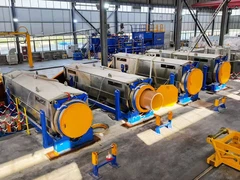
In the Jacking Pipe Production Line, concrete pipes are usually made using a process called centrifugal casting. This involves pouring concrete into a rotating mold, which helps to distribute the concrete evenly and create a dense, uniform pipe wall. The Centrifugal Casting Fiberglass Pipeline Production Line can also be adapted in some cases to produce high - quality concrete jacking pipes, as the principle of centrifugal force application is similar.
Fiberglass Reinforced Plastic (FRP)
FRP is another popular material for jacking pipes. It's a composite material made up of fiberglass fibers embedded in a polymer resin matrix. One of the main advantages of FRP pipes is their light weight. Compared to concrete pipes, FRP pipes are much easier to handle and transport, which can save a lot of time and money on the construction site.
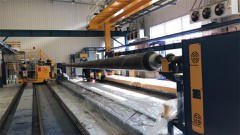
They're also highly resistant to corrosion, even in harsh chemical environments. This makes them a great choice for applications where the pipes will be exposed to aggressive substances, like industrial wastewater or seawater. In the Jacking Pipe Production Line, FRP pipes are produced by winding fiberglass rovings around a mandrel and then impregnating them with resin. The Jacking Pipe Production Line we supply is well - equipped to handle the production of FRP jacking pipes with high precision and efficiency.
Steel
Steel pipes are also used in jacking operations, especially in situations where high strength and flexibility are required. Steel is an extremely strong material, and steel pipes can be designed to withstand very high axial and bending loads. They're also very flexible, which means they can be bent to follow the curvature of the underground path during the jacking process.
However, steel pipes are prone to corrosion, so they usually need to be coated with a protective layer, such as epoxy or polyethylene, to prevent rusting. In the Jacking Pipe Production Line, steel pipes are typically formed by rolling steel sheets into a tubular shape and then welding the seams.
Ductile Iron
Ductile iron is a type of cast iron that has been treated to make it more ductile and less brittle than traditional cast iron. Ductile iron pipes offer a good balance between strength and flexibility. They're strong enough to withstand the forces involved in jacking operations, but they're also flexible enough to adapt to minor ground movements without cracking.
Ductile iron pipes are produced in the Jacking Pipe Production Line using a casting process similar to that used for concrete pipes. They're then coated with a protective layer to prevent corrosion.
Polyvinyl Chloride (PVC)
PVC is a lightweight and cost - effective material that's also used in the production of jacking pipes. PVC pipes are easy to install and are resistant to corrosion and chemical attack. They're commonly used in smaller - scale jacking projects, such as residential sewer lines or irrigation systems.
In the Jacking Pipe Production Line, PVC pipes are extruded through a die to form the desired shape. They can be produced in a variety of sizes and thicknesses to meet different project requirements.
Choosing the Right Material
When it comes to choosing the right material for jacking pipes, there are several factors to consider. The first is the specific application of the pipes. For example, if the pipes will be used in a sewage system, corrosion resistance will be a major concern, so materials like FRP or PVC might be a good choice. If the pipes need to withstand high loads, such as in a large - scale water main project, concrete or steel pipes might be more appropriate.
The soil conditions at the construction site also play a crucial role. If the soil is acidic or contains a lot of abrasive particles, a corrosion - resistant and wear - resistant material like FRP or ductile iron should be considered. The budget is another important factor. Some materials, like steel and FRP, can be more expensive than others, like PVC or concrete. So, it's important to find a balance between cost and performance.
As a supplier of the Jacking Pipe Production Line, we have the expertise and experience to help you choose the right production process and materials for your specific needs. Our production lines are designed to be versatile and can be customized to produce pipes from different materials with high quality and efficiency.
If you're in the market for a Jacking Pipe Production Line or have any questions about the materials used in the production process, don't hesitate to reach out. We're here to assist you in making the best decisions for your business and your projects. Whether you're a small - scale contractor or a large construction company, we can provide you with the solutions you need to produce top - notch jacking pipes.
Let's work together to take your pipe production to the next level. Contact us today to start the conversation about your Jacking Pipe Production Line needs!
References
- "Underground Pipe Engineering Handbook"
- "Materials for Civil Engineering Construction"
Send Inquiry