



How does 'Countinue winding' compare to hand - winding in terms of quality?
Sep 15, 2025
Leave a message
When it comes to the manufacturing of composite products, winding techniques play a crucial role in determining the quality of the final output. Two prominent methods in this field are continuous winding and hand - winding. As a continuous winding supplier, I have witnessed firsthand the differences between these two techniques in terms of quality. In this blog, I will provide a detailed comparison of continuous winding and hand - winding, highlighting the advantages and disadvantages of each method.
Precision and Consistency
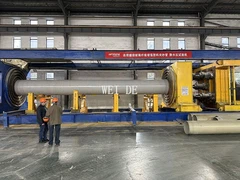
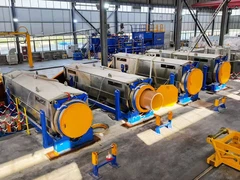
One of the most significant differences between continuous winding and hand - winding is the level of precision and consistency achieved. Continuous winding, as the name implies, is a highly automated process. Machines such as the CFW Continuous Pipe Winding Machine are designed to wind fibers around a mandrel with extreme accuracy. These machines can control the tension, angle, and pitch of the winding process with a high degree of repeatability. This means that every product produced using continuous winding will have the same high - quality specifications, minimizing variations between individual pieces.
On the other hand, hand - winding is a more labor - intensive process. While skilled artisans can produce high - quality products, there is always a greater potential for human error. The tension applied to the fibers, the angle of winding, and the overall uniformity of the winding can vary from one piece to another. This lack of consistency can lead to differences in the mechanical properties of the final products, which may not be acceptable in applications where precision is critical, such as aerospace or high - performance automotive components.
Production Speed
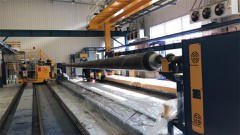
Continuous winding also offers a significant advantage in terms of production speed. Automated continuous winding machines can operate at a much faster pace than human hands. The Continuous Fiberglass Pipe Winding Machine can wind fibers continuously without the need for breaks, resulting in a high volume of products being produced in a relatively short period. This is particularly beneficial for large - scale production runs, where meeting tight deadlines is essential.
In contrast, hand - winding is a slow process. Each piece has to be wound individually, and the speed is limited by the physical capabilities of the worker. This makes hand - winding less suitable for mass production. However, for small - batch or custom - made products, hand - winding may still be a viable option, as it allows for more flexibility in design and adjustments during the winding process.
Material Utilization
In terms of material utilization, continuous winding is generally more efficient. Automated machines can be programmed to use the exact amount of fiber required for each product, minimizing waste. The winding process is optimized to ensure that the fibers are laid down in the most efficient pattern, reducing the amount of excess material. Additionally, continuous winding machines can often handle different types of fibers and resins more effectively, allowing for better integration of materials and improved overall product quality.


Hand - winding, on the other hand, may result in more material waste. Since it is a manual process, it can be more difficult to control the amount of fiber used precisely. There may also be more instances of fibers being cut or discarded during the winding process due to mistakes or the need for adjustments. This not only increases the cost of production but also has a negative impact on the environment.
Complexity of Design
When it comes to handling complex designs, continuous winding has its limitations. While modern continuous winding machines are capable of producing a wide range of shapes and sizes, there are still some geometric configurations that are difficult to achieve. The winding process is typically based on a set of pre - programmed patterns, and creating highly irregular or complex shapes may require significant modifications to the machine or the use of additional tooling.
Hand - winding, however, offers greater flexibility in terms of design. Skilled artisans can adapt to different shapes and sizes more easily, and they can make on - the - spot adjustments to the winding process to accommodate complex geometries. This makes hand - winding a preferred choice for products with unique or intricate designs, such as artistic or custom - made composite structures.
Quality of Surface Finish
The surface finish of the final product is another important aspect to consider. Continuous winding machines are designed to produce a smooth and uniform surface finish. The automated process ensures that the fibers are laid down evenly, and the use of appropriate tooling and finishing techniques can result in a high - quality surface that requires minimal post - processing.
In hand - winding, the surface finish can be more variable. The skill of the worker plays a significant role in determining the quality of the surface. While a highly skilled artisan can produce a beautiful finish, there is a greater risk of unevenness, bumps, or other imperfections due to the manual nature of the process. This may require more extensive post - processing, such as sanding or polishing, to achieve the desired surface quality.
Cost - effectiveness
Cost - effectiveness is a major factor in any manufacturing decision. Continuous winding is generally more cost - effective for large - scale production. The initial investment in continuous winding equipment, such as the Composite Material Winding Equipment, can be high. However, when spread over a large number of products, the cost per unit is relatively low due to the high production speed, efficient material utilization, and consistent quality.
Hand - winding, on the other hand, is more expensive on a per - unit basis. The labor cost associated with hand - winding is relatively high, especially when considering the time required to produce each piece. Additionally, the potential for material waste and the need for more extensive post - processing can further increase the cost. However, for small - scale or high - end custom products, the added cost of hand - winding may be justified by the unique design and craftsmanship.
Conclusion
In conclusion, both continuous winding and hand - winding have their own advantages and disadvantages in terms of quality. Continuous winding offers high precision, consistency, production speed, and material utilization, making it ideal for large - scale production of standard products. On the other hand, hand - winding provides greater flexibility in design and can produce unique, high - quality products with a personal touch, making it suitable for small - batch or custom - made items.
As a continuous winding supplier, I believe that continuous winding is the future of composite manufacturing for most industrial applications. The ability to produce high - quality products efficiently and cost - effectively is essential in today's competitive market. However, I also recognize the value of hand - winding in certain niche markets.
If you are interested in exploring the benefits of continuous winding for your manufacturing needs, I encourage you to contact us for a detailed discussion. We can provide you with more information about our CFW Continuous Pipe Winding Machine, Continuous Fiberglass Pipe Winding Machine, and Composite Material Winding Equipment. Our team of experts is ready to assist you in finding the best solution for your specific requirements.
References
- Ashby, M. F., & Jones, D. R. H. (2012). Engineering Materials 1: An Introduction to Properties, Applications, and Design. Butterworth - Heinemann.
- Gibson, R. F. (2012). Principles of Composite Material Mechanics. CRC Press.
- Strong, A. B. (2008). Plastics: Materials and Processing. Pearson Prentice Hall.
Send Inquiry