



What is the impact of electromagnetic interference on the operation of a four axis filament winding machine?
Dec 04, 2025
Leave a message
Electromagnetic interference (EMI) is a phenomenon that can significantly affect the operation of various electronic devices, including the four-axis filament winding machines we supply. As a leading provider of these advanced machines, understanding the impact of EMI on their functionality is crucial for ensuring optimal performance and reliability.
Understanding Electromagnetic Interference
Electromagnetic interference refers to the disturbance that affects an electrical circuit due to either electromagnetic induction or electromagnetic radiation emitted from an external source. EMI can be classified into two main types: conducted and radiated. Conducted EMI travels along power lines and signal cables, while radiated EMI propagates through the air as electromagnetic waves.
Sources of EMI are diverse and can come from both natural and man - made origins. Natural sources include lightning strikes, which generate intense electromagnetic pulses. Man - made sources are more common in industrial settings and can include motors, generators, power supplies, and radio frequency transmitters. In a manufacturing environment where our four - axis filament winding machines are used, there are numerous potential EMI sources, such as other machinery, welding equipment, and even nearby communication devices.
Impact on the Four - Axis Filament Winding Machine
1. Control System Malfunctions
The control system of a four - axis filament winding machine is the brain that coordinates all the movements and operations. It is highly sensitive to EMI. When exposed to significant levels of electromagnetic interference, the control system may experience errors in signal processing. For example, the position sensors that determine the exact location of the winding head and the mandrel can provide inaccurate readings. This can lead to misalignment during the winding process, resulting in uneven filament distribution on the workpiece. If the mandrel rotation speed is not accurately controlled due to EMI - induced signal errors, it can cause variations in the winding tension, affecting the overall quality of the wound product.
2. Communication Issues
Modern four - axis filament winding machines often rely on communication protocols to transfer data between different components, such as between the control unit and the motor drives. EMI can disrupt these communication channels. For instance, in a serial communication system, electromagnetic interference can introduce noise into the data stream, leading to data corruption. This can cause the machine to receive incorrect instructions or fail to transmit critical information. As a result, the machine may not operate synchronously, leading to production delays and potential damage to the equipment.
3. Motor Performance Degradation
The motors in a four - axis filament winding machine are responsible for driving the various axes, including the mandrel rotation, the lateral movement of the winding head, and the traverse motion. EMI can have a direct impact on motor performance. It can cause fluctuations in the motor's input voltage and current, leading to unstable motor operation. This instability can manifest as jerky movements, speed variations, or even motor stalling. Over time, repeated exposure to EMI can also cause premature wear and tear on the motor components, reducing the motor's lifespan and increasing maintenance costs.
4. Safety Risks
In addition to affecting the machine's performance, EMI can pose safety risks. If the control system malfunctions due to electromagnetic interference, it may not be able to execute safety protocols correctly. For example, emergency stop functions may be delayed or fail to activate in case of an unexpected situation. This can put operators at risk of injury and damage to the machine and the surrounding environment.
Mitigation Strategies
As a four - axis filament winding machine supplier, we are committed to providing solutions to minimize the impact of EMI.
1. Shielding
One of the most effective ways to reduce EMI is through shielding. We use conductive materials to enclose sensitive components, such as the control system and the motor drives. These shields act as a barrier, preventing electromagnetic waves from penetrating and interfering with the internal circuitry. For example, metal enclosures can be used to house the control panels, and shielded cables can be employed to transmit signals between different parts of the machine.
2. Filtering
Filtering is another important technique. We install EMI filters in the power supply lines and signal cables. These filters are designed to block unwanted frequencies while allowing the desired signals to pass through. By removing the high - frequency noise caused by EMI, the filters help to ensure stable operation of the machine's electrical components.
3. Grounding
Proper grounding is essential for dissipating electromagnetic energy safely. We ensure that all the electrical components of the four - axis filament winding machine are properly grounded. A good grounding system provides a low - resistance path for the electrical current, preventing the build - up of static charges and reducing the risk of EMI.


Our Product Range
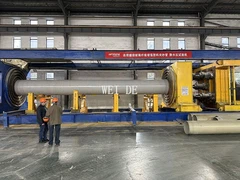
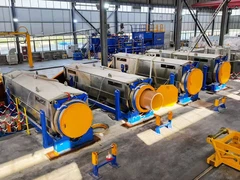
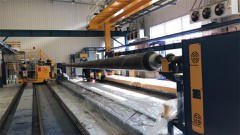
We offer a wide range of four - axis filament winding machines, including the Pressure Cylinder Winding Machine, Type 4 Cylinder Winding Machine, and Type 3 Cylinder Winding Machine. These machines are designed with advanced anti - EMI features to ensure reliable operation in various industrial environments. Our engineers continuously work on improving the EMI resistance of our products to meet the ever - increasing demands of our customers.
Conclusion
Electromagnetic interference can have a profound impact on the operation of a four - axis filament winding machine, affecting its control system, communication, motor performance, and safety. However, with the right mitigation strategies, such as shielding, filtering, and grounding, we can minimize these effects. As a supplier, we are dedicated to providing high - quality machines that are resilient to EMI. If you are in the market for a four - axis filament winding machine, we invite you to contact us for a detailed discussion on how our products can meet your specific requirements. We look forward to partnering with you to achieve your production goals.
References
- Henry Ott, "Electromagnetic Compatibility Engineering".
- National Electrical Manufacturers Association (NEMA) standards related to EMI in industrial equipment.
- IEEE publications on electromagnetic interference and its mitigation in electrical systems.
Send Inquiry