



What is the production flow for epoxy - coated pipes?
Nov 28, 2025
Leave a message
Epoxy-coated pipes are widely used in various industries due to their excellent corrosion resistance, durability, and smooth inner surface, which helps in reducing fluid friction. As a leading epoxy pipe production supplier, I am excited to share the detailed production flow of epoxy-coated pipes with you.
1. Raw Material Preparation
The first step in the production of epoxy-coated pipes is the careful selection and preparation of raw materials. The base pipe, which can be made of steel, stainless steel, or other suitable metals, is sourced from reliable suppliers. The quality of the base pipe is crucial as it forms the foundation of the epoxy-coated pipe.
We conduct strict quality checks on the incoming base pipes, including dimensional accuracy, surface smoothness, and material composition. Any pipes that do not meet our high - quality standards are rejected.
In addition to the base pipe, the epoxy resin is another key raw material. Epoxy resins are thermosetting polymers known for their strong adhesion, chemical resistance, and mechanical properties. We choose high - grade epoxy resins that are specifically formulated for pipe coating applications. These resins are often supplied in liquid form and need to be stored and handled properly to maintain their quality.
2. Pipe Surface Pretreatment
Before applying the epoxy coating, the surface of the base pipe must be properly pretreated. This step is essential to ensure good adhesion between the pipe and the epoxy coating.
- Cleaning: The base pipes are first thoroughly cleaned to remove any dirt, grease, oil, or other contaminants. This can be achieved through methods such as solvent cleaning or alkaline cleaning. Solvent cleaning involves using organic solvents to dissolve and remove the contaminants, while alkaline cleaning uses alkaline solutions to break down and remove the dirt.
- Rust Removal: Rust and oxidation on the pipe surface can significantly affect the adhesion of the epoxy coating. Therefore, rust removal is a critical part of the pretreatment process. We commonly use methods like sandblasting or shot - blasting. Sandblasting involves propelling fine sand particles at high speed onto the pipe surface to remove rust and scale. Shot - blasting uses small steel shots to achieve the same purpose. These methods not only remove rust but also create a rough surface on the pipe, which enhances the mechanical bonding between the pipe and the epoxy coating.
- Surface Activation: After cleaning and rust removal, the pipe surface may be further treated to activate it. This can be done through chemical treatments or by using primers. Primers are thin layers of special coatings that are applied to the pipe surface before the main epoxy coating. They help to improve the adhesion of the epoxy coating and provide additional corrosion protection.
3. Epoxy Coating Application
Once the pipe surface is properly pretreated, it is ready for the application of the epoxy coating. There are several methods for applying epoxy coatings, and the choice of method depends on factors such as the pipe size, coating thickness requirements, and production volume.


- Spraying: Spraying is a common method for applying epoxy coatings on pipes. In this process, the epoxy resin is atomized into fine droplets using a spray gun and then evenly sprayed onto the pipe surface. The spraying process can be automated or manual. Automated spraying systems are often used for large - scale production, as they can ensure consistent coating thickness and quality. Manual spraying may be used for smaller pipes or for touch - up work.
- Dipping: Dipping is another method where the pipe is immersed in a tank filled with the epoxy resin. This method is suitable for pipes with complex shapes or for achieving a thick coating. When the pipe is dipped into the resin, the epoxy adheres to the pipe surface, and the excess resin is drained off.
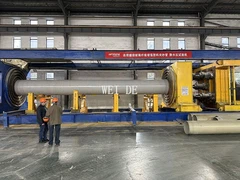
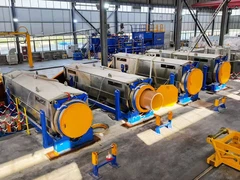
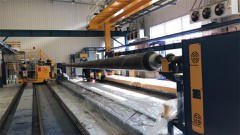
- Epoxy Horizontal Winding Machine and Epoxy Pipe Winding Machine: For some applications, especially when a high - strength and uniform coating is required, epoxy filament winding machines are used. These machines wind continuous filaments impregnated with epoxy resin around the pipe in a precise pattern. This method can create a strong and durable coating with excellent mechanical properties.
4. Curing Process
After the epoxy coating is applied, the pipe needs to go through a curing process. Curing is the chemical reaction that transforms the liquid epoxy resin into a solid, cross - linked polymer.
- Temperature and Time Control: The curing process is highly dependent on temperature and time. Different epoxy resins have different curing requirements. In general, higher temperatures can accelerate the curing process, but excessive temperatures may cause the coating to crack or develop other defects. We carefully control the curing temperature and time based on the specific epoxy resin used. For example, some epoxy coatings may require a curing temperature of around 80 - 120°C for a few hours, while others may cure at room temperature over a longer period.
- Curing Ovens: In most cases, curing ovens are used to ensure a controlled curing environment. The pipes are placed inside the oven, and the temperature and air circulation are precisely regulated. The oven can be heated by electricity, gas, or other energy sources.
5. Quality Inspection
Once the curing process is complete, the epoxy - coated pipes undergo a comprehensive quality inspection. This step is crucial to ensure that the pipes meet the required standards and specifications.
- Coating Thickness Measurement: The thickness of the epoxy coating is an important parameter. We use non - destructive testing methods such as ultrasonic thickness gauges or magnetic induction thickness gauges to measure the coating thickness at multiple points on the pipe. The coating thickness should be within the specified range to ensure proper corrosion protection and mechanical performance.
- Adhesion Testing: Adhesion testing is carried out to evaluate the bond strength between the epoxy coating and the pipe surface. This can be done through methods such as cross - hatch testing or pull - off testing. In cross - hatch testing, a grid of cuts is made on the coating surface, and then an adhesive tape is applied and pulled off. The amount of coating that comes off with the tape indicates the adhesion strength. Pull - off testing involves using a special device to pull a small area of the coating away from the pipe surface and measuring the force required to do so.
- Visual Inspection: A visual inspection is also conducted to check for any surface defects such as cracks, pinholes, or uneven coating. Any pipes with visible defects are either re - worked or rejected.
6. Packaging and Storage
After passing the quality inspection, the epoxy - coated pipes are ready for packaging and storage.
- Packaging: The pipes are carefully packaged to protect the epoxy coating during transportation and storage. We use materials such as plastic wraps, wooden pallets, or steel bands for packaging. Plastic wraps can prevent the pipes from being scratched or damaged, while wooden pallets provide a stable base for stacking the pipes. Steel bands are used to secure the pipes during transportation.
- Storage: The packaged pipes are stored in a dry and cool environment. Exposure to high humidity, extreme temperatures, or direct sunlight can damage the epoxy coating. Therefore, we store the pipes in warehouses with proper ventilation and temperature control.
Contact for Purchase and Negotiation
As a professional epoxy pipe production supplier, we are committed to providing high - quality epoxy - coated pipes that meet your specific requirements. Whether you need pipes for water supply systems, oil and gas pipelines, or other industrial applications, we have the expertise and resources to deliver the best solutions.
If you are interested in our epoxy - coated pipes or would like to discuss your specific needs, please feel free to contact us. We look forward to establishing a long - term business relationship with you.
References
- ASTM International. (20XX). Standard specifications for epoxy - coated steel pipes.
- ISO. (20XX). International standards for pipe coating and corrosion protection.
- Technical literature from epoxy resin suppliers.
Send Inquiry