



What is the production process flow of a marine fiberglass pipeline production line?
Oct 15, 2025
Leave a message
Hey there! As a supplier of Marine Fiberglass Pipeline Production Lines, I'm super stoked to walk you through the production process flow. It's a fascinating journey from raw materials to the final product, and I'm gonna break it down for you step by step.
Step 1: Raw Material Preparation
The first thing we need to do is gather all the necessary raw materials. For marine fiberglass pipelines, the main ingredients are fiberglass roving and resin. The fiberglass roving is like the backbone of the pipeline, providing strength and durability. The resin, on the other hand, acts as the glue that holds everything together.
We source high - quality fiberglass roving from trusted suppliers. It comes in large spools, and we make sure it meets all the industry standards. The resin is usually a type of epoxy resin, which is known for its excellent chemical resistance and mechanical properties. We also add some additives to the resin to improve its performance, like UV stabilizers to protect the pipeline from sunlight damage.
Step 2: Mixing the Resin
Once we have the raw materials, it's time to mix the resin. We use a special mixing machine to ensure that the resin and additives are evenly distributed. This is a crucial step because if the resin is not mixed properly, it can lead to weak spots in the pipeline.
We follow a strict recipe for the resin mixture, carefully measuring out each component. The mixing process usually takes a few minutes, and during this time, we constantly monitor the temperature and viscosity of the resin. Once the resin is well - mixed, it's ready to be used in the winding process.


Step 3: Winding the Fiberglass
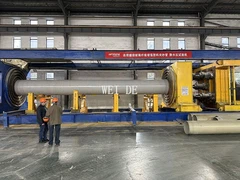
Now comes the core part of the production process - winding the fiberglass. We use an Epoxy Horizontal Winding Machine for this task. The winding machine has a rotating mandrel, which is the shape around which the fiberglass will be wound.
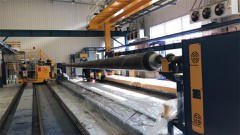
The fiberglass roving is passed through the resin bath, where it gets coated with the resin. Then, it's wound onto the mandrel in a precise pattern. The pattern of the winding is carefully designed to ensure that the pipeline has the right strength and flexibility. The winding speed and tension are also closely controlled to achieve the best results.
As the fiberglass is being wound, we can also add multiple layers to increase the thickness and strength of the pipeline. This is especially important for marine applications, where the pipeline needs to withstand high pressures and harsh environmental conditions.
Step 4: Curing the Pipeline
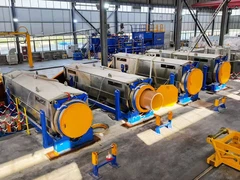
After the winding is complete, the pipeline needs to be cured. Curing is the process of hardening the resin, which gives the pipeline its final strength. We use a curing oven to speed up the curing process.
The pipeline is placed inside the oven at a specific temperature for a set period of time. The temperature and time depend on the type of resin used. During the curing process, the resin undergoes a chemical reaction that transforms it from a liquid to a solid state.
We monitor the curing process closely to make sure that the pipeline is cured evenly. If the curing is not done properly, the pipeline may have internal stresses or may not reach its full strength potential.
Step 5: Removing the Mandrel
Once the pipeline is fully cured, it's time to remove the mandrel. This is usually a delicate process because we don't want to damage the pipeline. We use special tools to carefully extract the mandrel from the inside of the pipeline.
After the mandrel is removed, the pipeline is inspected for any defects. We check for things like cracks, voids, or uneven surfaces. If any defects are found, we take the necessary steps to repair them.
Step 6: Cutting and Finishing
The next step is to cut the pipeline to the desired length. We use a cutting machine to make precise cuts. After cutting, we also do some finishing work on the pipeline. This includes sanding the edges to make them smooth and applying a protective coating.
The protective coating helps to further enhance the pipeline's resistance to corrosion and abrasion. It also gives the pipeline a nice, professional look.
Step 7: Quality Testing
Before the pipeline is ready to be shipped, it undergoes a series of quality tests. We test the pipeline for things like pressure resistance, chemical resistance, and mechanical strength.
We use specialized testing equipment to perform these tests. For example, we use a pressure testing machine to check how much pressure the pipeline can withstand without leaking or bursting. If the pipeline passes all the tests, it's considered ready for the market.
Step 8: Packaging and Shipping
Once the pipeline has passed all the quality tests, it's time to package it for shipping. We use protective packaging materials to ensure that the pipeline is not damaged during transportation.
The packaged pipelines are then loaded onto trucks or containers and shipped to our customers. We work with reliable shipping partners to ensure that the pipelines are delivered on time and in good condition.
Other Applications and Related Machines
Our Marine Fiberglass Pipeline Production Line can also be used to produce other types of pipelines, such as High - pressure Petroleum Pipeline Production Line. And if you're interested in a more specialized machine for pipe winding, we also offer the Epoxy Pipe Winding Machine.
These machines are designed to meet different production needs and can be customized according to your specific requirements. Whether you're in the marine industry, oil and gas industry, or any other industry that requires high - quality fiberglass pipelines, we've got you covered.
Why Choose Our Production Line
Our production line is built with the latest technology and high - quality components. This ensures that the pipelines produced are of the highest quality and can meet the most demanding industry standards.
We also offer excellent after - sales service. Our team of experts is always ready to provide technical support and help you with any issues that you may encounter. We believe in building long - term relationships with our customers, and we're committed to your success.
Contact Us for Purchase and Negotiation
If you're interested in our Marine Fiberglass Pipeline Production Line or any of our other products, don't hesitate to get in touch with us. We're more than happy to discuss your needs, provide you with a quote, and answer any questions you may have. Whether you're a small business looking to start production or a large corporation in need of an upgrade, we can work with you to find the best solution.
References
- Fiberglass Pipe Manufacturing Handbook
- Epoxy Resin Technology and Applications
So, that's the production process flow of a marine fiberglass pipeline production line. I hope this blog has given you a better understanding of how these amazing pipelines are made. If you have any more questions, feel free to reach out!
Send Inquiry