




Continuous Filament Winding Machine Structure Analysis
Jun 11, 2025
Leave a message
Continuous filament winding machines are high-precision equipment widely used in composite material manufacturing, primarily for producing high-strength and lightweight products such as pipes, storage tanks, and pressure vessels. Their core function is to achieve automated winding of complex geometries by precisely controlling the compounding process of continuous fiber and resin.
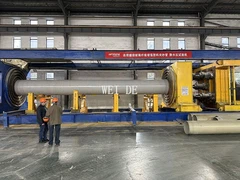
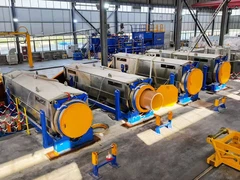
Structurally, a continuous filament winding machine primarily consists of a frame, drive system, control system, fiber supply unit, and resin impregnation unit. The frame is the machine's basic support structure and is typically welded from high-strength steel to ensure overall rigidity and stability. The drive system includes a spindle and servo motor. The spindle rotates the mold, while the servo motor precisely controls the speed to meet the winding requirements of different products.
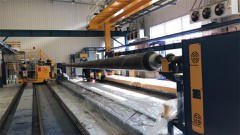
The control system, the "brain" of the machine, typically consists of a PLC or industrial computer, enabling precise control of the winding path, tension, and number of layers. Modern winding machines generally utilize CNC technology, enabling programming to achieve complex three-dimensional winding paths, thereby improving product consistency and performance. The fiber supply unit is responsible for evenly delivering continuous fibers (such as glass and carbon fibers) to the winding area while maintaining stable fiber tension to prevent breakage or loosening. The resin impregnation unit is used to evenly saturate the fibers with resin, typically using a dipping tank or in-line impregnation technology to ensure a thorough bonding between the fibers and the resin. Some high-end equipment also features heating or curing modules to accelerate the resin curing process and improve production efficiency.
The precise structure and intelligent control of continuous filament winding machines make them key equipment in composite material manufacturing, providing high-performance solutions for industries such as aerospace, automotive, and energy. With continued technological advancement, winding machines will continue to develop towards automation and multifunctionality.
Send Inquiry