




Technical Features Of The Centrifugal Casting FRP Pipe Production Line
Jun 27, 2025
Leave a message
The centrifugal casting FRP pipe production line is an efficient and precise process for manufacturing composite pipes. Its technical features are primarily reflected in material properties, production processes, equipment structure, and product quality control. This line uses high-speed centrifugal force to fully bond the resin and glass fibers, creating high-strength, corrosion-resistant pipe products. These products are widely used in water supply and drainage, chemical engineering, and power generation.
Material Performance Advantages
Centrifugally cast FRP pipes utilize a glass fiber-reinforced resin-based composite material with excellent mechanical properties and chemical stability. The glass fibers provide high strength and rigidity, while the resin matrix imparts excellent corrosion and aging resistance. Compared to traditional steel or concrete pipes, FRP pipes are lightweight, have high tensile strength, and are less susceptible to corrosion from chemical media such as acids, alkalis, and salts, resulting in a service life of over 50 years. Furthermore, their smooth inner wall and low fluid resistance effectively reduce transportation energy consumption.
Production Process Features
The core of the centrifugal casting process lies in the high-speed rotation of the mold, which evenly distributes and compacts the resin and glass fibers under the action of centrifugal force. This process ensures uniform pipe wall thickness, high density, and the absence of bubbles and delamination defects by precisely controlling rotation speed, temperature, and curing time. Production lines typically utilize automated control systems to monitor and adjust process parameters in real time to ensure product consistency and stability. Compared to hand lay-up or winding processes, centrifugal casting offers higher production efficiency and is suitable for large-scale industrial production.
Equipment Structure and Technical Highlights
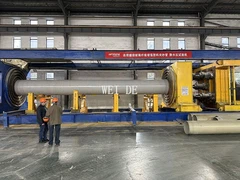
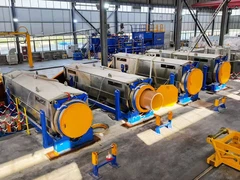
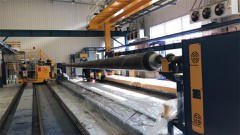
Key equipment in a centrifugal casting FRP pipe production line includes a high-speed centrifuge, a resin mixing system, a mold heating device, and a cooling system. The centrifuge utilizes high-precision bearings and a drive system to ensure mold stability during high-speed rotation, preventing vibration that could affect product quality. The resin mixing system precisely blends resin, curing agent, and filler to ensure consistent material properties. Mold heating typically uses electric or steam heating to ensure rapid curing of the resin at the optimal temperature, improving production efficiency. The cooling system uses air or water cooling to control pipe shrinkage, reduce internal stress, and enhance dimensional accuracy.
Quality Control and Environmental Advantages
The production line is equipped with in-line inspection equipment, such as ultrasonic thickness gauges and wall thickness scanners, to monitor pipe thickness and uniformity in real time to ensure compliance with industry standards. Furthermore, the FRP pipe production process produces no harmful gases, meeting environmental protection requirements, and waste materials are recyclable, reducing the environmental burden.
In summary, centrifugally cast FRP pipe production lines, with their excellent material properties, efficient and stable processes, intelligent equipment, and environmentally friendly advantages, have become a key technological direction in modern pipe manufacturing, providing reliable and durable pipe solutions for various industries.

Send Inquiry