



Can 3D printed GRP pipes be used in the education sector?
Jan 15, 2026
Leave a message
Can 3D printed GRP pipes be used in the education sector?
In recent years, 3D printing technology has revolutionized various industries, offering innovative solutions to long - standing challenges. As a supplier of 3D printed Glass - Reinforced Plastic (GRP) pipes, I've been closely observing the potential applications of these products, especially in the education sector. This blog post aims to explore whether 3D printed GRP pipes can find a place in educational institutions.
1. Understanding 3D Printed GRP Pipes
GRP pipes are well - known for their high strength, corrosion resistance, and lightweight properties. Traditional manufacturing methods for GRP pipes involve processes like filament winding. However, 3D printing technology has opened up new possibilities for creating GRP pipes. With 3D printing, we can achieve complex geometries that are difficult or impossible to produce using conventional methods.
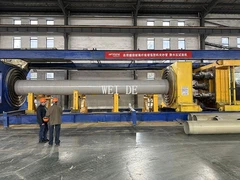
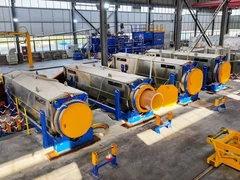
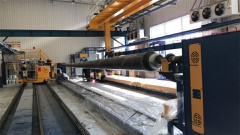
Our company utilizes advanced CFW Continuous Pipe Winding Machine and Composite Material Winding Equipment to ensure the high - quality production of 3D printed GRP pipes. These machines allow us to precisely control the fiber orientation and resin distribution, resulting in pipes with excellent mechanical properties.
2. Educational Applications in Science and Engineering Courses
In science and engineering courses, 3D printed GRP pipes can serve as valuable teaching tools. For example, in fluid mechanics courses, these pipes can be used to demonstrate the flow of fluids under different conditions. The transparency of some GRP materials can be an advantage, enabling students to visually observe the fluid behavior inside the pipes, such as laminar and turbulent flows.
In materials science courses, students can study the composition and properties of GRP. They can analyze how the glass fibers and resin matrix interact to provide the pipe with its strength and durability. By comparing 3D printed GRP pipes with those made by traditional methods, students can gain a deeper understanding of the advantages and limitations of different manufacturing processes.
Moreover, in civil engineering courses, 3D printed GRP pipes can be used to simulate drainage systems or small - scale water supply networks. Students can design and build their own models using these pipes, learning about pipe sizing, layout, and connection techniques. This hands - on experience is invaluable for their future careers.


3. Promoting Innovation and Creativity
The ability to 3D print GRP pipes allows for a high degree of customization. In an educational setting, this can encourage students to think creatively and come up with innovative designs. For instance, students can design pipes with unique cross - sectional shapes or internal structures to optimize fluid flow or reduce pressure loss.
The use of 3D printed GRP pipes also provides an opportunity for interdisciplinary projects. Students from different fields such as mechanical engineering, electrical engineering, and environmental science can collaborate on projects related to the development of smart pipes. These pipes could be equipped with sensors to monitor various parameters like pressure, temperature, and flow rate, which can then be used for real - time data analysis and system optimization.
4. Cost - effectiveness and Sustainability
One of the concerns in the education sector is cost. 3D printing technology can offer a cost - effective solution for producing GRP pipes. Since the production process is digital, there is no need for expensive molds or tooling, which significantly reduces the initial investment. Additionally, 3D printing allows for on - demand production, minimizing waste.
In terms of sustainability, GRP pipes are already known for their long service life and low maintenance requirements. 3D printing further enhances this aspect by reducing material waste during the manufacturing process. The ability to recycle the materials used in 3D printed GRP pipes also makes them an environmentally friendly option for educational institutions.
5. Challenges and Considerations
While 3D printed GRP pipes have great potential in the education sector, there are also some challenges to overcome. One of the main challenges is the lack of standardized testing methods for 3D printed GRP pipes. Educational institutions need to ensure that the pipes they use meet certain quality and safety standards.
Another challenge is the need for specialized knowledge and skills to operate 3D printing equipment. Teachers and technicians may require training to effectively use and maintain the equipment. However, this can also be seen as an opportunity to introduce new skills and knowledge into the curriculum.
6. Conclusion and Call to Action
In conclusion, 3D printed GRP pipes have significant potential for use in the education sector. They can enhance teaching and learning experiences in science and engineering courses, promote innovation and creativity, and offer cost - effective and sustainable solutions.
As a supplier of 3D printed GRP pipes, we are committed to providing high - quality products and support to educational institutions. If you are interested in exploring the use of 3D printed GRP pipes in your educational programs, we would be more than happy to discuss your specific needs and requirements. Contact us to start a conversation about how our products can benefit your institution.
References
- Ashby, M. F. (2005). Materials selection in mechanical design. Butterworth - Heinemann.
- Gibson, I., Rosen, D. W., & Stucker, B. (2010). Additive manufacturing technologies: rapid prototyping to direct digital manufacturing. Springer Science & Business Media.
- Mallick, P. K. (2007). Fiber - reinforced composites: materials, manufacturing, and design. CRC press.
Send Inquiry