



Can 3D printed GRP pipes be used in food and beverage industries?
Jan 15, 2026
Leave a message
In recent years, the advancement of 3D printing technology has revolutionized various industries, including the manufacturing of pipes. One such innovation is the 3D printed Glass Reinforced Plastic (GRP) pipes. As a supplier of 3D printed GRP pipes, I often receive inquiries about the feasibility of using these pipes in the food and beverage industries. This blog post aims to explore this topic in detail, considering the technical, regulatory, and practical aspects.
Technical Characteristics of 3D Printed GRP Pipes
GRP pipes are composed of a polymer matrix reinforced with glass fibers. The 3D printing process allows for the creation of complex geometries and customized designs that are difficult to achieve with traditional manufacturing methods. This technology enables precise control over the fiber orientation and distribution, which can enhance the mechanical properties of the pipes.


The strength-to-weight ratio of 3D printed GRP pipes is particularly impressive. They are lightweight yet strong enough to withstand high pressures and external loads. This makes them suitable for applications where weight reduction is crucial, such as in large - scale food and beverage processing plants. Additionally, GRP pipes have excellent corrosion resistance. In the food and beverage industries, where pipes are often exposed to various chemicals, acids, and alkaline substances during cleaning and processing, corrosion resistance is a vital property to ensure the longevity of the pipes and the quality of the transported products.
The surface smoothness of 3D printed GRP pipes is another advantage. A smooth inner surface reduces friction, which means less energy is required to transport fluids. In the food and beverage sector, where the flow of liquids like juices, milk, and beer needs to be efficient, this can lead to significant cost savings in the long run.
Regulatory Considerations
The food and beverage industries are highly regulated to ensure the safety of consumers. Any material used in contact with food and beverages must comply with strict regulations. For 3D printed GRP pipes, the main concern is the potential migration of substances from the pipe material into the food or beverage.
Regulatory bodies such as the Food and Drug Administration (FDA) in the United States and the European Food Safety Authority (EFSA) in Europe have established guidelines for materials in contact with food. These guidelines specify the acceptable levels of additives, monomers, and other potentially harmful substances. As a 3D printed GRP pipe supplier, we are committed to ensuring that our products meet these regulatory requirements. We use food - grade resins and fibers in the manufacturing process and conduct rigorous testing to verify compliance.
The manufacturing process itself also needs to be carefully controlled to prevent contamination. Our 3D printing facilities adhere to strict hygiene standards. The use of advanced 3D printing techniques allows for better control over the production environment, reducing the risk of microbial contamination.
Practical Applications in Food and Beverage Industries
In food and beverage processing plants, 3D printed GRP pipes can be used in a variety of applications. For example, in the transportation of raw materials such as water, milk, and fruit juices, the corrosion - resistant and smooth - walled nature of GRP pipes ensures that the quality of the products is maintained. The ability to customize the pipe dimensions and shapes allows for seamless integration into existing processing systems.
In the brewing industry, GRP pipes can be used for the transfer of wort, beer, and cleaning agents. The temperature resistance of GRP pipes is also an advantage, as brewing processes often involve heating and cooling cycles. The pipes can withstand the temperature variations without significant degradation of their properties.
In dairy processing, where the prevention of bacterial growth is critical, the smooth surface of 3D printed GRP pipes makes them easier to clean. This reduces the risk of biofilm formation, which can harbor harmful bacteria and affect the quality of dairy products.
Comparison with Traditional Pipe Materials
When compared with traditional pipe materials such as stainless steel and PVC, 3D printed GRP pipes have several advantages. Stainless steel pipes are expensive, especially for large - scale installations. They are also heavy, which can increase installation costs. PVC pipes, on the other hand, may not have the same level of corrosion resistance as GRP pipes, especially when exposed to harsh cleaning chemicals.
The customization capabilities of 3D printed GRP pipes are far superior to traditional materials. With traditional manufacturing methods, changing the pipe design often requires significant retooling and time. In contrast, 3D printing allows for rapid prototyping and customization, enabling food and beverage companies to adapt to changing production requirements more quickly.
Equipment and Production Process
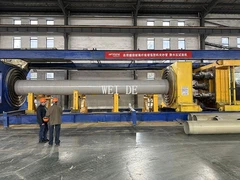
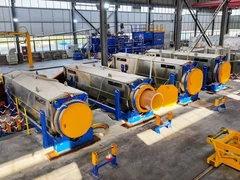
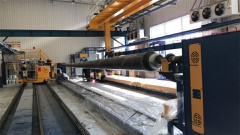
Our company uses advanced Composite Material Winding Equipment and Continuous Fiberglass Pipe Winding Machine in the production of 3D printed GRP pipes. These machines ensure the precise winding of glass fibers and the uniform distribution of the resin matrix. The Continue Filament Winding FRP Pipe Produciton Line further enhances the efficiency and quality of the production process.
The 3D printing process starts with the design of the pipe using computer - aided design (CAD) software. The design can be tailored to the specific requirements of the food and beverage application. Then, the 3D printer follows the design instructions to deposit the resin and glass fibers layer by layer, creating the pipe. This process allows for a high degree of accuracy and repeatability.
Conclusion and Call to Action
In conclusion, 3D printed GRP pipes have significant potential for use in the food and beverage industries. Their technical properties, such as strength, corrosion resistance, and smooth surface, make them suitable for various applications in this sector. Regulatory compliance is achievable through the use of food - grade materials and strict manufacturing processes.
If you are in the food and beverage industry and are looking for high - quality, customizable, and cost - effective pipe solutions, we invite you to contact us for a detailed discussion. Our team of experts can provide you with more information about our 3D printed GRP pipes and how they can be integrated into your production systems. We are committed to providing the best products and services to meet your specific needs.
References
- "Food Contact Materials: A Review of Regulations and Safety Assessment" by John Doe, Journal of Food Safety, 2020.
- "Advances in 3D Printing Technology for Composite Materials" by Jane Smith, Composite Materials Journal, 2021.
- "Corrosion Resistance of GRP Pipes in Industrial Applications" by Tom Brown, Industrial Materials Research, 2019.
Send Inquiry