



Can a Continuous Fiberglass Pipe Winding Machine be used for other fiber - related products?
Sep 19, 2025
Leave a message
As a supplier of Continuous Fiberglass Pipe Winding Machines, I often get asked whether these machines can be used for other fiber-related products. This question is not only relevant for potential customers looking to diversify their production but also for industries aiming to optimize their manufacturing processes. In this blog post, I will explore the versatility of Continuous Fiberglass Pipe Winding Machines and discuss their potential applications beyond traditional fiberglass pipe production.
Understanding Continuous Fiberglass Pipe Winding Machines
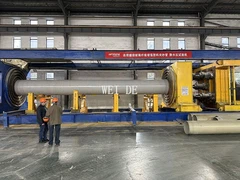
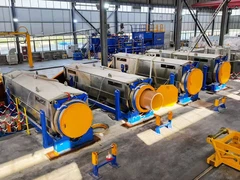
Before delving into their alternative uses, it's essential to understand how Continuous Fiberglass Pipe Winding Machines work. These machines are designed to produce fiberglass pipes by winding continuous strands of fiberglass around a rotating mandrel. The fiberglass strands are typically impregnated with a resin matrix, which cures to form a strong and durable composite material. The winding process can be controlled to achieve different pipe diameters, wall thicknesses, and fiber orientations, allowing for the production of pipes with varying mechanical properties.
The key components of a Continuous Fiberglass Pipe Winding Machine include a resin bath, a fiber creel, a winding head, and a mandrel. The resin bath is used to impregnate the fiberglass strands with resin, while the fiber creel holds the spools of fiberglass. The winding head guides the fiberglass strands onto the rotating mandrel, and the mandrel provides the shape and support for the pipe during the winding process.
Potential Applications for Other Fiber-Related Products
While Continuous Fiberglass Pipe Winding Machines are primarily used for producing fiberglass pipes, they can also be adapted for other fiber-related products. Here are some potential applications:
Composite Tubes and Rods
Continuous Fiberglass Pipe Winding Machines can be used to produce composite tubes and rods with different diameters and lengths. These products are commonly used in industries such as aerospace, automotive, and sports equipment. By adjusting the winding parameters, such as the fiber orientation and the number of layers, it is possible to produce tubes and rods with specific mechanical properties, such as high strength, stiffness, and fatigue resistance.
Fiberglass Reinforced Plastics (FRP) Panels
FRP panels are widely used in construction, transportation, and industrial applications due to their lightweight, high strength, and corrosion resistance. Continuous Fiberglass Pipe Winding Machines can be used to produce FRP panels by winding fiberglass strands onto a flat mandrel. The panels can be produced in different sizes and thicknesses, and they can be customized with different surface finishes and colors.
Pressure Vessels
Pressure vessels are used to store and transport fluids and gases under pressure. Continuous Fiberglass Pipe Winding Machines can be used to produce composite pressure vessels by winding fiberglass strands around a cylindrical mandrel. The winding process can be optimized to achieve the required strength and pressure resistance of the vessel. Composite pressure vessels offer several advantages over traditional metal vessels, such as lightweight, corrosion resistance, and longer service life.
Wind Turbine Blades
Wind turbine blades are one of the most critical components of a wind turbine. They are designed to capture the energy of the wind and convert it into electrical energy. Continuous Fiberglass Pipe Winding Machines can be used to produce wind turbine blades by winding fiberglass strands onto a blade-shaped mandrel. The winding process can be controlled to achieve the required aerodynamic shape and mechanical properties of the blade. Composite wind turbine blades offer several advantages over traditional metal blades, such as lightweight, high strength, and better fatigue resistance.
Advantages of Using Continuous Fiberglass Pipe Winding Machines for Other Fiber-Related Products
Using Continuous Fiberglass Pipe Winding Machines for other fiber-related products offers several advantages:
High Productivity
Continuous Fiberglass Pipe Winding Machines are designed for high-speed production, which means that they can produce large quantities of fiber-related products in a short period of time. This makes them ideal for industries that require high-volume production.
Consistent Quality
The winding process of Continuous Fiberglass Pipe Winding Machines is highly automated, which ensures consistent quality of the fiber-related products. The machines can be programmed to control the winding parameters, such as the fiber tension, the winding speed, and the resin content, to achieve the desired mechanical properties of the products.
Customization
Continuous Fiberglass Pipe Winding Machines can be easily customized to produce fiber-related products with different sizes, shapes, and mechanical properties. This makes them suitable for a wide range of applications and industries.


Cost-Effective
Using Continuous Fiberglass Pipe Winding Machines for other fiber-related products can be cost-effective compared to traditional manufacturing methods. The machines require less labor and energy, and they can produce products with a higher quality and consistency, which reduces the overall production cost.
Challenges and Considerations
While Continuous Fiberglass Pipe Winding Machines offer many advantages for producing other fiber-related products, there are also some challenges and considerations that need to be addressed:
Material Compatibility
Different fiber materials and resin systems have different properties, which means that they may require different winding parameters and processing conditions. It is important to ensure that the fiber material and resin system are compatible with the Continuous Fiberglass Pipe Winding Machine and the intended application.
Tooling and Mandrel Design
The tooling and mandrel design play a crucial role in the production of fiber-related products. The mandrel needs to be designed to provide the desired shape and support for the product during the winding process, and the tooling needs to be designed to ensure that the fiber strands are wound evenly and accurately.
Process Optimization
The winding process of Continuous Fiberglass Pipe Winding Machines needs to be optimized to achieve the desired mechanical properties of the fiber-related products. This may require adjusting the winding parameters, such as the fiber tension, the winding speed, and the resin content, based on the specific requirements of the product.
Safety and Environmental Considerations
The production of fiber-related products using Continuous Fiberglass Pipe Winding Machines involves the use of resin systems, which may contain hazardous chemicals. It is important to ensure that the production process is carried out in a safe and environmentally friendly manner, and that the necessary safety measures are in place to protect the workers and the environment.
Conclusion
In conclusion, Continuous Fiberglass Pipe Winding Machines can be used for other fiber-related products beyond traditional fiberglass pipe production. These machines offer high productivity, consistent quality, customization, and cost-effectiveness, making them suitable for a wide range of applications and industries. However, there are also some challenges and considerations that need to be addressed, such as material compatibility, tooling and mandrel design, process optimization, and safety and environmental considerations.
If you are interested in using a Continuous Fiberglass Pipe Winding Machine for your fiber-related product manufacturing, I encourage you to explore our Composite Material Winding Equipment and CFW Continuous Pipe Winding Machine options. Our Continuous Fiberglass Pipe Winding Machine is designed to meet the highest standards of quality and performance, and our team of experts can provide you with the support and guidance you need to optimize your production process. Contact us today to discuss your specific requirements and explore how our machines can help you achieve your manufacturing goals.
References
- "Fiber Reinforced Polymer Composites: Materials, Manufacturing, and Design" by David Hull and T. W. Clyne
- "Composite Materials: Design and Applications" by Daniel Hull and Timothy W. Clyne
- "Filament Winding Technology" by S. T. Peters
Send Inquiry