



Can composite material winding equipment wind continuous fiber composite materials?
Oct 31, 2025
Leave a message
As a supplier of Composite Material Winding Equipment, I am often asked the question: "Can composite material winding equipment wind continuous fiber composite materials?" The answer is a resounding yes, and in this blog post, I will delve into the details of how our equipment can effectively wind continuous fiber composite materials, the benefits of doing so, and why you should consider our solutions for your production needs.
Understanding Continuous Fiber Composite Materials
Continuous fiber composite materials are a class of advanced materials that consist of continuous fibers, such as carbon fiber, glass fiber, or aramid fiber, embedded in a matrix material, typically a polymer resin. These materials offer exceptional mechanical properties, including high strength, stiffness, and lightweight characteristics, making them ideal for a wide range of applications in industries such as aerospace, automotive, marine, and sports equipment.


The continuous fibers in these composites provide the primary load-bearing capacity, while the matrix material holds the fibers in place, transfers loads between them, and protects them from environmental damage. The combination of these two components results in a material that is stronger and lighter than traditional materials like steel or aluminum.
How Composite Material Winding Equipment Works
Our Composite Material Winding Equipment is designed to precisely wind continuous fiber composite materials onto a mandrel, which is a shaped core that determines the final shape of the composite part. The winding process involves several key steps:
- Fiber Preparation: The continuous fibers are first unwound from spools and passed through a resin bath, where they are impregnated with the matrix material. This step ensures that the fibers are fully coated with resin and ready for winding.
- Winding: The impregnated fibers are then guided onto the rotating mandrel using a set of guides and tensioning devices. The winding pattern can be controlled to achieve the desired fiber orientation and thickness distribution in the composite part. Our equipment offers a variety of winding patterns, including helical, hoop, and polar winding, to meet the specific requirements of different applications.
- Curing: After the winding process is complete, the composite part is cured to harden the resin and bond the fibers together. Curing can be done using heat, pressure, or a combination of both, depending on the type of resin used. Our equipment can be integrated with curing ovens or autoclaves to ensure a consistent and efficient curing process.
Advantages of Winding Continuous Fiber Composite Materials
There are several advantages to using our Composite Material Winding Equipment to wind continuous fiber composite materials:
- High Strength and Stiffness: By precisely controlling the fiber orientation and thickness distribution, our equipment can produce composite parts with exceptional strength and stiffness. This makes them suitable for applications where high performance is required, such as aerospace components and automotive parts.
- Lightweight Design: Continuous fiber composite materials are significantly lighter than traditional materials, which can lead to weight savings in the final product. This is particularly important in industries where weight reduction is a key factor, such as aerospace and automotive.
- Customization: Our equipment allows for a high degree of customization in terms of fiber type, resin system, winding pattern, and part geometry. This means that we can produce composite parts that are tailored to the specific needs of our customers, whether it's a complex aerospace component or a simple sporting good.
- Efficiency and Productivity: Our advanced winding technology and automation features enable us to produce composite parts with high efficiency and productivity. This results in shorter production times and lower costs compared to traditional manufacturing methods.
Applications of Wound Continuous Fiber Composite Materials
The ability to wind continuous fiber composite materials using our equipment opens up a wide range of applications in various industries:
- Aerospace: In the aerospace industry, wound composite parts are used in aircraft structures, such as wings, fuselages, and tail sections, to reduce weight and improve fuel efficiency. They are also used in satellite components, where high strength and stiffness are required in a lightweight package.
- Automotive: In the automotive industry, wound composite parts are used in engine components, suspension systems, and body panels to reduce weight and improve performance. They can also be used in electric vehicle batteries to improve energy density and reduce charging times.
- Marine: In the marine industry, wound composite parts are used in boat hulls, decks, and masts to reduce weight and improve corrosion resistance. They are also used in offshore structures, such as wind turbine blades and oil rig components, where high strength and durability are required.
- Sports Equipment: In the sports equipment industry, wound composite parts are used in golf clubs, tennis rackets, bicycles, and other sporting goods to improve performance and reduce weight. They offer a combination of strength, stiffness, and flexibility that is ideal for these applications.
Our Product Range
We offer a comprehensive range of Composite Material Winding Equipment to meet the diverse needs of our customers. Our product range includes:
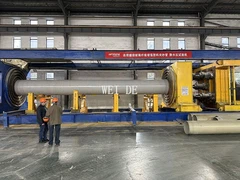
- Continuous Fiberglass Pipe Winding Machine: This machine is specifically designed for winding continuous fiberglass pipes with high precision and efficiency. It can produce pipes with different diameters and lengths, making it suitable for a wide range of applications in the plumbing, oil and gas, and construction industries.
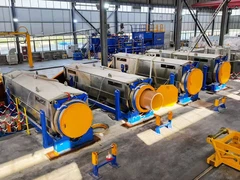
- Composite Material Winding Equipment: Our general-purpose composite material winding equipment can be used to wind a variety of continuous fiber composite materials, including carbon fiber, glass fiber, and aramid fiber. It offers a high degree of flexibility and customization, allowing us to produce composite parts with complex shapes and geometries.
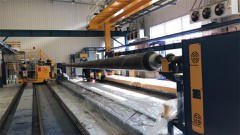
- Continue Filament Winding FRP Pipe Produciton Line: This production line is designed for the mass production of FRP (Fiber Reinforced Plastic) pipes. It includes all the necessary equipment for fiber preparation, winding, and curing, and can be integrated with automated handling systems to improve productivity and efficiency.
Why Choose Our Composite Material Winding Equipment
There are several reasons why you should choose our Composite Material Winding Equipment for your production needs:
- Quality and Reliability: Our equipment is built to the highest standards of quality and reliability. We use only the best materials and components in our manufacturing process, and each machine is thoroughly tested before it leaves our factory. This ensures that our equipment will perform consistently and reliably in your production environment.
- Technical Expertise: Our team of engineers and technicians has extensive experience in the design and manufacture of composite material winding equipment. We can provide you with technical support and advice throughout the entire process, from equipment selection to installation and commissioning.
- Customization: We understand that every customer has unique requirements, and we are committed to providing customized solutions that meet your specific needs. Our equipment can be tailored to your exact specifications, including winding pattern, part geometry, and production capacity.
- After-Sales Service: We offer comprehensive after-sales service to ensure that your equipment continues to perform at its best. Our service team is available 24/7 to provide technical support, maintenance, and repair services, and we also offer training programs to help your operators get the most out of our equipment.
Contact Us for a Consultation
If you are interested in learning more about our Composite Material Winding Equipment and how it can help you produce high-quality composite parts, please contact us for a consultation. Our sales team will be happy to discuss your requirements and provide you with a detailed quote. We look forward to working with you to achieve your production goals.
References
- "Composite Materials: Design and Applications" by Isaac M. Daniel and Ori Ishai
- "Filament Winding Technology" by J. Summerscales
- "Handbook of Composites" edited by I. M. Daniel and O. Ishai
Send Inquiry