



How does 'Countinue winding' affect the magnetic properties of a coil?
Dec 29, 2025
Leave a message
The concept of "Continuous winding" is a remarkable process with profound implications for the magnetic properties of coils. As a seasoned supplier of continuous winding solutions, I've witnessed firsthand how this technique can transform the performance of coils used in various applications. In this blog, we'll explore the intricate relationship between continuous winding and the magnetic properties of coils, shedding light on the science behind the process and its real - world applications.
Understanding Continuous Winding
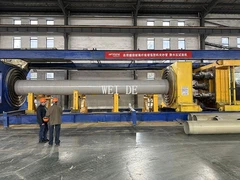
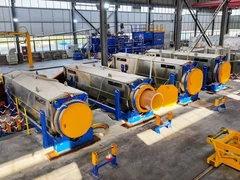
Continuous winding is a manufacturing process where a wire or filament is wound seamlessly around a core without interruptions. Unlike traditional winding methods that may involve stops and starts, continuous winding ensures a smooth and consistent distribution of the winding material. This process is made possible by advanced Composite Material Winding Equipment, which can precisely control the speed, tension, and direction of the winding.
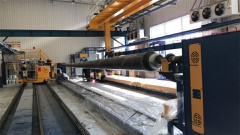
The equipment used in continuous winding is designed to handle different types of materials, including copper, aluminum, and various composite materials. For instance, in the production of Continue Filament Winding FRP Pipe Produciton Line, continuous winding allows for the efficient creation of high - strength pipes with uniform properties.
Impact on Magnetic Field Strength
One of the primary ways continuous winding affects the magnetic properties of a coil is by influencing the magnetic field strength. When a current passes through a coil, a magnetic field is generated around it. The strength of this magnetic field is directly proportional to the number of turns in the coil and the current flowing through it, as described by Ampere's law.
In continuous winding, the consistent and uniform distribution of turns ensures that each turn contributes effectively to the overall magnetic field. Unlike in non - continuous winding, where irregularities in the winding pattern can lead to local variations in the magnetic field, continuous winding provides a more homogeneous magnetic field. This homogeneity results in a more efficient energy transfer and a stronger overall magnetic field, which is crucial for applications such as transformers and electromagnets.
For example, in a power transformer, a stronger and more uniform magnetic field allows for better voltage regulation and reduced energy losses. The continuous winding process ensures that the magnetic flux is evenly distributed across the core of the transformer, minimizing the risk of hotspots and improving the overall performance and reliability of the device.


Influence on Magnetic Permeability
Magnetic permeability is a measure of how easily a material can be magnetized. In a coil, the magnetic permeability of the core material and the winding configuration play a significant role in determining the overall magnetic properties. Continuous winding can have a positive impact on magnetic permeability in several ways.
Firstly, the tight and consistent winding achieved through continuous winding can enhance the coupling between the turns of the coil and the core material. This improved coupling allows the magnetic field generated by the coil to penetrate the core more effectively, increasing the magnetic permeability. Additionally, the uniform distribution of the winding reduces the presence of air gaps or voids within the coil structure. Air gaps can act as barriers to the magnetic field, reducing the overall magnetic permeability. By minimizing these air gaps, continuous winding helps to maintain a higher magnetic permeability.
In applications such as inductors, a higher magnetic permeability is desirable as it allows for a greater inductance value with a smaller physical size. This is particularly important in modern electronics, where space is often at a premium. The CFW Continuous Pipe Winding Machine can be used to create coils with optimal winding configurations to enhance magnetic permeability for inductor applications.
Eddy Current Reduction
Eddy currents are circulating currents induced within conductors by a changing magnetic field. In coils, eddy currents can cause energy losses in the form of heat, reducing the efficiency of the device. Continuous winding can help reduce eddy current losses in coils.
The uniform and continuous nature of the winding process allows for a more controlled distribution of the magnetic field. This reduces the local variations in the magnetic field that can induce eddy currents. Additionally, continuous winding can be used to create coils with specific geometries that minimize the cross - sectional area available for eddy current flow. For example, by using a more compact and well - organized winding pattern, the path for eddy currents can be restricted, leading to a reduction in energy losses.
In high - frequency applications such as radiofrequency (RF) coils, eddy current reduction is crucial for maintaining signal integrity and minimizing power consumption. Continuous winding techniques can be tailored to meet the specific requirements of these applications, ensuring that the coils operate efficiently at high frequencies.
Real - World Applications
The improved magnetic properties achieved through continuous winding have a wide range of real - world applications. In the automotive industry, continuous - wound coils are used in electric motors and actuators. The stronger and more uniform magnetic fields produced by these coils result in higher motor efficiency, better torque control, and reduced energy consumption. This translates into improved vehicle performance and extended battery life in electric and hybrid vehicles.
In the aerospace industry, the lightweight and high - performance characteristics of continuous - wound coils make them ideal for use in avionics systems, navigation equipment, and communication devices. The ability to reduce eddy current losses and enhance magnetic permeability ensures reliable operation in the demanding aerospace environment.
In power generation and distribution, continuous - wound transformers and reactors play a crucial role in ensuring efficient energy transfer and voltage regulation. The improved magnetic properties of these coils help to reduce energy losses during transmission and distribution, contributing to a more sustainable and reliable power grid.
Why Choose Our Continuous Winding Solutions
As a leading supplier of continuous winding solutions, we offer a range of products and services that are tailored to meet the specific needs of our customers. Our state - of - the - art equipment, such as the Composite Material Winding Equipment and CFW Continuous Pipe Winding Machine, allows us to produce high - quality coils with precise winding configurations.
We have a team of experienced engineers and technicians who are dedicated to ensuring the highest level of quality and performance in our products. Whether you need coils for low - power electronics or high - voltage power applications, we can provide customized solutions that meet your requirements.
Contact Us for Procurement
If you're interested in learning more about how our continuous winding solutions can improve the magnetic properties of your coils and enhance the performance of your products, we encourage you to contact us for a procurement discussion. Our team is ready to assist you in selecting the right products and technologies for your specific application.
References
- Bozorth, R. M. (1951). Ferromagnetism. Van Nostrand.
- Grover, F. W. (1946). Inductance Calculations: Working Formulas and Tables. Dover Publications.
- White, R. M. (1980). Classical theory of magnetism. Wiley.
Send Inquiry