



How to improve the mechanical properties of 3D printed GRP pipes?
Nov 12, 2025
Leave a message
As a supplier of 3D printed GRP (Glass Reinforced Plastic) pipes, I understand the significance of enhancing the mechanical properties of these pipes. GRP pipes are widely used in various industries due to their excellent corrosion resistance, lightweight nature, and high strength-to-weight ratio. However, in certain applications, further improvement of their mechanical properties is required to meet the demanding performance criteria. In this blog post, I will share some effective strategies to enhance the mechanical properties of 3D printed GRP pipes.
1. Material Selection
The choice of materials is crucial in determining the mechanical properties of 3D printed GRP pipes. The two main components of GRP pipes are the resin matrix and the glass fibers.
Resin Matrix
Selecting a high - quality resin is essential. Epoxy resins are often preferred for their excellent adhesion to glass fibers, high chemical resistance, and good mechanical properties. They offer high tensile and flexural strength, which can significantly contribute to the overall strength of the GRP pipe. Polyester resins are also commonly used due to their lower cost, but they may have relatively lower mechanical performance compared to epoxy resins. By carefully choosing the type of resin and its formulation, we can optimize the mechanical properties of the pipe. For example, some resins can be modified with additives to improve their toughness and impact resistance.
Glass Fibers
The type, orientation, and volume fraction of glass fibers play a vital role in the mechanical performance of GRP pipes. E - glass fibers are the most commonly used type in GRP pipes due to their good balance of strength, cost, and chemical resistance. S - glass fibers, on the other hand, have higher strength and modulus, which can be used in applications where higher mechanical performance is required.
The orientation of glass fibers can be controlled during the 3D printing process. Aligning the fibers in the direction of the principal stress can significantly enhance the strength of the pipe. For example, in a pipe under internal pressure, aligning the fibers circumferentially can improve the hoop strength. Increasing the volume fraction of glass fibers also generally leads to an increase in the mechanical properties of the GRP pipe. However, there is a limit to the volume fraction that can be achieved, as a very high volume fraction may lead to poor resin impregnation and void formation.
2. 3D Printing Process Optimization
The 3D printing process itself can have a significant impact on the mechanical properties of GRP pipes.
Printing Parameters
Parameters such as printing speed, temperature, and layer thickness need to be carefully optimized. A slower printing speed can allow for better resin impregnation of the glass fibers and more uniform deposition of the material, which can improve the mechanical properties. The printing temperature also affects the viscosity of the resin and the curing process. Maintaining an appropriate temperature can ensure proper curing of the resin and good bonding between the layers.
Layer thickness is another important parameter. A thinner layer thickness can result in a more homogeneous structure and better mechanical properties. However, reducing the layer thickness too much may increase the printing time and cost. Therefore, a balance needs to be struck between layer thickness and mechanical performance.
Printing Path Planning
The printing path planning determines the orientation and distribution of the glass fibers in the pipe. By carefully designing the printing path, we can achieve the desired fiber orientation and distribution. For example, using a helical printing path can provide a combination of axial and circumferential fiber orientation, which can improve both the axial and hoop strength of the pipe.
3. Post - Processing
Post - processing steps can further enhance the mechanical properties of 3D printed GRP pipes.
Curing
Proper curing is essential for the development of the full mechanical properties of the GRP pipe. After 3D printing, the pipe may need to undergo a post - curing process at an elevated temperature for a certain period of time. This can ensure complete curing of the resin and improve the cross - linking density, which in turn enhances the strength and stiffness of the pipe.
Surface Treatment
Surface treatment can improve the mechanical performance of the pipe, especially its resistance to external damage. Applying a protective coating on the surface of the pipe can prevent scratches and abrasion, which can otherwise lead to crack initiation and propagation. Additionally, surface treatment can also improve the chemical resistance of the pipe.
4. Hybrid Manufacturing Approaches
Combining 3D printing with other manufacturing processes can also be an effective way to improve the mechanical properties of GRP pipes.
Filament Winding
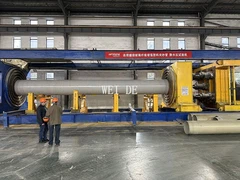
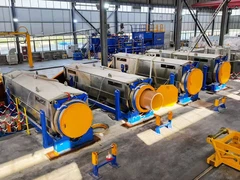
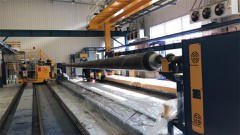
Filament winding is a well - established process for manufacturing GRP pipes. By combining 3D printing with filament winding, we can take advantage of the benefits of both processes. For example, 3D printing can be used to create complex geometries or internal structures, while filament winding can be used to reinforce the pipe with continuous glass fibers. You can learn more about filament winding processes from our Continue Filament Winding FRP Pipe Produciton Line, Continuous Fiberglass Pipe Winding Machine, and CFW Continuous Pipe Winding Machine.
Co - Extrusion
Co - extrusion can be used to create multi - layer GRP pipes with different material properties in each layer. For example, a layer with high strength fibers can be combined with a layer with good corrosion resistance. This can result in a pipe with improved overall mechanical and chemical performance.
5. Quality Control
Implementing a strict quality control system is essential to ensure that the 3D printed GRP pipes meet the required mechanical properties.
Non - Destructive Testing
Non - destructive testing methods such as ultrasonic testing, X - ray testing, and thermography can be used to detect internal defects such as voids, delaminations, and fiber misalignments. By detecting these defects early, corrective actions can be taken to improve the quality of the pipes.


Mechanical Testing
Regular mechanical testing of the 3D printed GRP pipes is necessary to verify their mechanical properties. Tensile testing, flexural testing, and impact testing can be performed to measure the strength, stiffness, and toughness of the pipes. Based on the test results, the manufacturing process can be adjusted to improve the mechanical performance.
Conclusion
Improving the mechanical properties of 3D printed GRP pipes requires a comprehensive approach that includes material selection, 3D printing process optimization, post - processing, hybrid manufacturing, and quality control. By carefully considering each of these aspects, we can produce GRP pipes with enhanced mechanical performance that meet the requirements of various applications.
If you are interested in our 3D printed GRP pipes or have any questions about improving their mechanical properties, please feel free to contact us for further discussion and potential procurement. We are committed to providing high - quality products and solutions to meet your needs.
References
- Gibson, I., Rosen, D. W., & Stucker, B. (2015). Additive Manufacturing Technologies: 3D Printing, Rapid Prototyping, and Direct Digital Manufacturing. Springer.
- Mallick, P. K. (2008). Fiber - Reinforced Composites: Materials, Manufacturing, and Design. CRC Press.
- Strong, R. (2006). Plastics Materials and Processing. Prentice Hall.
Send Inquiry