



What is the difference between Horizongtal winding and vertical winding?
Oct 30, 2025
Leave a message
Hey there! As a supplier of horizontal winding equipment, I often get asked about the differences between horizontal winding and vertical winding. It's a topic that's not only crucial for those in the manufacturing and composite industries but also quite fascinating once you dig into it. So, let's break it down and see what sets these two winding methods apart.
Basics of Winding
Before we dive into the differences, let's quickly cover what winding is all about. Winding is a manufacturing process used to create various products, especially those made of composite materials. In simple terms, it involves wrapping fibers, like glass or carbon, around a mandrel (a shaped core) to build up layers and form a structure. This process is widely used in making things like pipes, tanks, and aerospace components.
Horizontal Winding
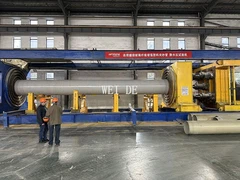
Let's start with horizontal winding, which is my area of expertise. In horizontal winding, the mandrel is placed horizontally on a rotating spindle. The fiber feeding system moves along the length of the mandrel, laying down the fibers in a controlled pattern.
One of the major advantages of horizontal winding is its stability. Since the mandrel is lying flat, there's less chance of it wobbling or vibrating during the winding process. This results in a more consistent and uniform winding, which is crucial for products that require high precision, like Epoxy Pipe Winding Machine.
Another benefit is the ease of loading and unloading the mandrel. You can simply roll it onto the spindle, which is much more straightforward compared to vertical winding. This also means that horizontal winding machines can handle larger and heavier mandrels more easily.
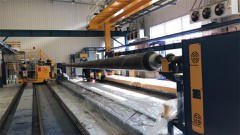
Horizontal winding is also great for creating long, cylindrical products. The horizontal setup allows for continuous winding along the length of the mandrel, making it ideal for manufacturing pipes and tubes. With the right machine, like an Epoxy Horizontal Winding Machine, you can produce pipes of various diameters and lengths with high efficiency.
Vertical Winding
Now, let's take a look at vertical winding. In this method, the mandrel is positioned vertically, and the fiber feeding system moves up and down around it.
One of the key advantages of vertical winding is the use of gravity. Gravity helps to keep the fibers in place as they are wound around the mandrel, which can be beneficial for some types of materials. It also allows for better control over the resin flow, especially when using a wet winding process.
Vertical winding is often used for products that have a more complex shape or require a specific orientation of the fibers. For example, it's commonly used in the production of spherical or conical components. The vertical setup allows for more flexibility in changing the winding angle and pattern, which can be useful for creating parts with unique structural requirements.


However, vertical winding also has its challenges. The mandrel needs to be securely fixed to prevent it from toppling over during the winding process. This can make the setup more complicated and time - consuming. Additionally, loading and unloading the mandrel can be more difficult, especially for larger and heavier ones.
Winding Pattern and Fiber Placement
When it comes to winding patterns and fiber placement, both horizontal and vertical winding have their own characteristics.
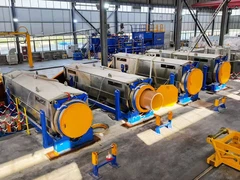
In horizontal winding, the most common patterns are helical and circumferential. Helical winding involves wrapping the fibers around the mandrel at an angle, which provides strength in both the axial and hoop directions. Circumferential winding, on the other hand, wraps the fibers around the circumference of the mandrel, providing hoop strength. These patterns are relatively easy to achieve in a horizontal setup, and they can be precisely controlled using modern winding machines like the Epoxy Filament Winding Machine.
In vertical winding, the winding patterns can be more diverse. Due to the vertical orientation, it's easier to create complex patterns that involve changes in the winding angle and direction. This is particularly useful for products that need to withstand multi - directional loads. However, achieving these complex patterns requires more advanced control systems and skilled operators.
Product Quality and Consistency
Product quality and consistency are crucial factors in any manufacturing process. Horizontal winding generally offers better consistency in terms of fiber distribution and thickness. The stable horizontal setup ensures that the fibers are laid down evenly across the mandrel, resulting in a more uniform product. This is especially important for products that need to meet strict quality standards, such as those used in the aerospace and automotive industries.
Vertical winding can also produce high - quality products, but it may require more careful monitoring and adjustment. The influence of gravity and the more complex winding patterns can sometimes lead to variations in fiber placement. However, with proper equipment and experienced operators, these issues can be minimized.
Production Efficiency
In terms of production efficiency, horizontal winding often has an edge. The ease of loading and unloading the mandrel, combined with the ability to handle larger mandrels, allows for faster production cycles. Horizontal winding machines can also be automated more easily, which further increases productivity.
Vertical winding, on the other hand, may have a slower production rate due to the more complex setup and the need for more precise control. However, for products that require the unique capabilities of vertical winding, the trade - off in production speed may be worth it.
Cost Considerations
Cost is always an important factor in manufacturing. Horizontal winding machines are generally more cost - effective in terms of initial investment. They are simpler in design and easier to manufacture, which means they are often priced lower than vertical winding machines.
In addition, the operating costs of horizontal winding are usually lower. The simpler setup and easier maintenance result in less downtime and lower repair costs. However, the cost - effectiveness also depends on the specific product requirements. If a product can only be made using vertical winding, then the higher cost may be justified.
Which One to Choose?
So, which winding method should you choose? Well, it depends on several factors. If you're looking to produce long, cylindrical products like pipes and tubes, and you value stability, ease of operation, and high - volume production, then horizontal winding is probably the way to go. You can take advantage of the efficiency and precision offered by machines like the Epoxy Horizontal Winding Machine.
On the other hand, if you need to create products with complex shapes or specific fiber orientations, and you're willing to deal with the additional setup and control requirements, then vertical winding may be more suitable.
Conclusion
In conclusion, both horizontal and vertical winding have their own unique advantages and disadvantages. As a supplier of horizontal winding equipment, I firmly believe in the capabilities of horizontal winding for many applications. But I also recognize the importance of vertical winding in certain industries and product types.
If you're in the market for a winding machine and you're not sure which type is right for you, feel free to reach out. We can discuss your specific requirements and help you make an informed decision. Whether you need an Epoxy Pipe Winding Machine or an Epoxy Filament Winding Machine, we're here to assist you in finding the best solution for your business. Let's start a conversation and see how we can work together to meet your manufacturing needs.
References
- "Composite Materials Manufacturing Processes" by John Summerscales
- "Filament Winding Technology" by A. P. Mouritz
Send Inquiry