



What is the role of the resin impregnation system in composite material winding equipment?
Dec 25, 2025
Leave a message
In the realm of composite material manufacturing, winding equipment plays a pivotal role in producing high - performance composite products. As a leading supplier of Composite Material Winding Equipment, I have witnessed firsthand the crucial role of the resin impregnation system within this equipment. In this blog, I'll delve into the significance of the resin impregnation system in composite material winding equipment.
Understanding Composite Material Winding Equipment
Composite material winding equipment is designed to create composite structures by winding continuous fibers, such as glass, carbon, or aramid fibers, around a rotating mandrel. These structures offer excellent strength - to - weight ratios, corrosion resistance, and other desirable properties, making them widely used in various industries, including aerospace, automotive, and infrastructure.
The winding process typically involves several key steps: fiber feeding, resin impregnation, winding on the mandrel, and curing. Each step is critical for achieving the desired quality and performance of the final composite product. Among these steps, resin impregnation is a fundamental and often underestimated process.
The Basics of Resin Impregnation
Resin impregnation is the process of thoroughly wetting the continuous fibers with a resin matrix. The resin serves as the binder that holds the fibers together and transfers the load between them. A well - impregnated fiber bundle ensures that the mechanical properties of the fibers are fully utilized, and the composite structure has high integrity.
There are different methods of resin impregnation, including dip impregnation, roller impregnation, and injection impregnation. Each method has its own advantages and is suitable for different types of composite material winding applications.
Role of the Resin Impregnation System in Composite Material Winding Equipment
1. Ensuring Uniform Fiber Wetting
One of the primary roles of the resin impregnation system is to ensure uniform wetting of the fibers. In composite manufacturing, non - uniform wetting can lead to dry spots in the final product. These dry spots can significantly reduce the mechanical strength and durability of the composite structure, as the load cannot be effectively transferred between the fibers.
The resin impregnation system is designed to control the resin flow and distribution around the fibers. For example, in a roller impregnation system, the rollers are adjusted to apply the right amount of pressure on the fiber bundle, squeezing the resin into the fiber gaps and ensuring that every fiber is coated with the resin. This uniform wetting is essential for achieving consistent quality in mass - produced composite products.
2. Controlling Resin Content
The resin content in a composite material is a critical parameter that affects its mechanical properties, such as stiffness, strength, and impact resistance. The resin impregnation system allows precise control of the resin content in the fiber - resin mixture.
By adjusting the resin flow rate, the speed of the fiber movement, and the impregnation pressure, the system can achieve the desired resin - to - fiber ratio. For instance, in applications where high strength is required, a lower resin content may be preferred to maximize the fiber volume fraction. On the other hand, in applications where good impact resistance is needed, a slightly higher resin content may be beneficial.
3. Improving Process Efficiency
The resin impregnation system can also improve the overall efficiency of the composite material winding process. A well - designed system can impregnate the fibers quickly and continuously, reducing the production time.
For example, an injection impregnation system can inject the resin directly into the fiber bundle at a high speed, minimizing the time required for the resin to penetrate the fibers. This not only speeds up the impregnation process but also allows for higher winding speeds, increasing the productivity of the composite material winding equipment.
4. Enhancing Product Quality and Performance
The quality of the resin impregnation has a direct impact on the performance of the final composite product. A properly impregnated composite structure has better resistance to environmental factors, such as moisture, chemicals, and UV radiation.
The resin acts as a protective barrier for the fibers, preventing them from being damaged by external agents. Additionally, a well - impregnated composite has improved fatigue resistance, which is crucial for applications where the structure is subjected to cyclic loading, such as in aerospace and automotive components.
Applications in Different Winding Processes
1. Filament Winding for Pipes
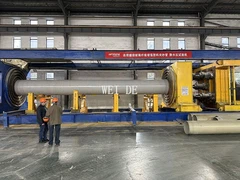
In the production of Continue Filament Winding FRP Pipe Produciton Line, the resin impregnation system is vital for ensuring the quality of the pipes. FRP pipes are widely used in water supply, sewage treatment, and oil and gas transportation.
The resin impregnation system in this application must be able to handle high - volume production while maintaining uniform resin distribution. For example, in a continuous filament winding process for pipes, the resin is continuously applied to the fibers as they are wound around the mandrel. The system ensures that the resin is evenly distributed along the length and circumference of the pipe, resulting in a pipe with consistent wall thickness and mechanical properties.
2. Winding for Composite Tanks
Composite tanks are used for storing various liquids and gases, such as fuel, water, and chemicals. The resin impregnation system in composite tank winding equipment is crucial for ensuring the tank's leak - proof and corrosion - resistant properties.
The system must be able to impregnate the fibers in a way that creates a seamless and strong bond between the layers of the composite structure. In addition, the resin used in tank applications often has special properties, such as chemical resistance and high - temperature resistance. The resin impregnation system needs to be compatible with these specialized resins and ensure their proper distribution in the fiber matrix.
3. Winding for Aerospace Components
In the aerospace industry, the performance requirements for composite components are extremely high. The resin impregnation system in CFW Continuous Pipe Winding Machine used for aerospace applications must be highly precise and reliable.
Aerospace components, such as wing spars and fuselage sections, require composites with extremely high strength - to - weight ratios and excellent fatigue resistance. The resin impregnation system must ensure that the fibers are perfectly wetted with a high - performance resin, and the resin content is accurately controlled to meet the strict design specifications.
Challenges and Solutions in Resin Impregnation
Despite its importance, the resin impregnation process in composite material winding equipment faces several challenges. One of the main challenges is the viscosity of the resin. High - viscosity resins can be difficult to impregnate into the fiber bundle, especially in fine - fiber applications.
To overcome this challenge, pre - heating the resin can be an effective solution. By increasing the temperature of the resin, its viscosity is reduced, making it easier to flow into the fiber gaps. Another solution is to use low - viscosity resins or resin systems with additives that can improve the resin's flowability.
Another challenge is the air entrapment during the impregnation process. Air bubbles in the resin can create weak points in the composite structure and reduce its mechanical properties. To address this issue, vacuum impregnation techniques can be used. Vacuum impregnation removes the air from the fiber bundle and the resin, ensuring a bubble - free impregnation.
Conclusion
The resin impregnation system is an integral part of composite material winding equipment. Its role in ensuring uniform fiber wetting, controlling resin content, improving process efficiency, and enhancing product quality and performance cannot be overstated.
As a supplier of composite material winding equipment, we understand the importance of a high - quality resin impregnation system. We are committed to providing our customers with advanced and reliable equipment that can meet the diverse needs of different industries.


If you are interested in our composite material winding equipment or have any questions about the resin impregnation process, please feel free to contact us. We are here to assist you in finding the best solutions for your composite manufacturing needs.
References
- Strong, A. B. (2008). Fundamentals of Composites Manufacturing: Materials, Methods, and Applications. Society of Manufacturing Engineers.
- Mallick, P. K. (2007). Fiber - Reinforced Composites: Materials, Manufacturing, and Design. CRC Press.
- Gibson, R. F. (2012). Principles of Composite Material Mechanics. CRC Press.
Send Inquiry