



What is the role of the winding head in composite material winding equipment?
Dec 08, 2025
Leave a message
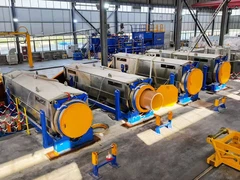
In the realm of composite material manufacturing, winding equipment plays a pivotal role in creating high - performance and reliable composite products. As a leading supplier of Composite Material Winding Equipment, I have witnessed firsthand the significance of each component within the winding system. Among these components, the winding head stands out as a critical part that significantly influences the quality, efficiency, and versatility of the winding process.
1. Basic Function of the Winding Head
The winding head is the core component responsible for guiding and laying the composite fibers onto the mandrel or substrate during the winding process. It controls the movement and placement of the fibers with high precision, ensuring that they are wound in the desired pattern and orientation. In essence, the winding head acts as the "hand" of the winding equipment, carefully arranging the fibers to build up the composite structure layer by layer.
One of the primary functions of the winding head is to control the tension of the fibers. Maintaining consistent tension is crucial for producing high - quality composite products. If the tension is too high, the fibers may break, leading to defects in the composite structure. On the other hand, if the tension is too low, the fibers may not be tightly packed, resulting in a weaker and less dense composite. The winding head is equipped with tension control mechanisms, such as tensioners and brakes, which can adjust the tension of the fibers in real - time based on the requirements of the winding process.
Another important function is the fiber placement. The winding head can move in multiple directions, including axial, radial, and circumferential directions, to achieve different winding patterns. For example, in helical winding, the winding head moves axially along the mandrel while rotating around it, creating a helical pattern of fibers. In hoop winding, the winding head moves only circumferentially around the mandrel, laying the fibers in a hoop - like pattern. These different winding patterns can be combined to optimize the mechanical properties of the composite product, such as strength, stiffness, and fatigue resistance.
2. Impact on Product Quality
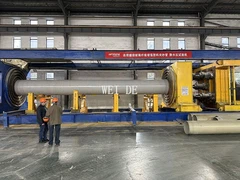
The performance of the winding head has a direct impact on the quality of the composite products. As mentioned earlier, precise tension control ensures that the fibers are evenly distributed and tightly packed within the composite structure. This uniformity in fiber distribution is essential for achieving consistent mechanical properties throughout the product. For instance, in the production of Continuous Fiberglass Pipe Winding Machine, a well - controlled winding head can produce pipes with uniform wall thickness and strength, reducing the risk of leaks and failures in service.
The accuracy of fiber placement also affects the quality of the composite. A high - precision winding head can place the fibers exactly where they are needed, minimizing the formation of voids and gaps in the composite. Voids are one of the most common defects in composite materials, as they can act as stress concentrators and reduce the overall strength and durability of the product. By precisely placing the fibers, the winding head helps to eliminate these voids and improve the integrity of the composite structure.
In addition, the winding head can also influence the surface finish of the composite product. A smooth and even winding process can result in a better - looking surface, which is not only aesthetically pleasing but also important for applications where the surface quality affects the performance of the product, such as in aerospace and automotive components.
3. Influence on Production Efficiency
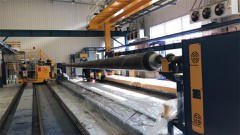
The winding head can significantly enhance the production efficiency of composite material winding equipment. Firstly, modern winding heads are designed to operate at high speeds without sacrificing precision. High - speed winding reduces the production time per unit, allowing manufacturers to increase their output and meet market demands more quickly. For example, in a Continue Filament Winding FRP Pipe Produciton Line, a high - speed winding head can produce more pipes in a shorter period, improving the overall productivity of the line.


Secondly, the winding head can be programmed to perform complex winding patterns automatically. This automation eliminates the need for manual intervention during the winding process, reducing the risk of human error and increasing the consistency of the products. Operators can simply input the desired winding parameters into the control system of the winding head, and it will execute the winding process accordingly. This not only saves time but also reduces labor costs.
Moreover, some advanced winding heads are equipped with quick - change mechanisms for different fiber types and winding patterns. This allows manufacturers to switch between different production tasks rapidly, increasing the flexibility of the winding equipment. For example, if a manufacturer needs to produce both helically wound and hoop - wound composite products, they can easily change the settings of the winding head to accommodate the different requirements.
4. Versatility and Adaptability
The winding head is a versatile component that can be adapted to different types of composite materials and winding applications. It can handle a wide range of fiber materials, including carbon fibers, glass fibers, aramid fibers, and natural fibers. Each type of fiber has its own unique properties, such as strength, stiffness, and chemical resistance, and the winding head can be adjusted to optimize the winding process for each specific fiber.
In terms of applications, the winding head can be used to produce various composite products, such as pipes, pressure vessels, aerospace components, and automotive parts. Different applications may require different winding patterns, fiber orientations, and product geometries. The winding head can be customized to meet these specific requirements. For example, in the production of aerospace components, the winding head may need to achieve very high - precision fiber placement to meet the strict quality and performance standards of the aerospace industry.
5. Technological Advancements in Winding Heads
The field of winding head technology is constantly evolving, driven by the demand for higher - quality composite products and more efficient production processes. One of the recent advancements is the integration of advanced sensors and control systems into the winding head. These sensors can monitor various parameters during the winding process, such as fiber tension, temperature, and position, in real - time. The control system can then adjust the operation of the winding head based on the sensor data, ensuring optimal performance and quality control.
Another technological trend is the development of multi - axis winding heads. These winding heads can move in more than three axes, allowing for more complex and precise winding patterns. For example, a five - axis winding head can perform both helical and hoop winding simultaneously, enabling the production of composite products with more sophisticated geometries.
In addition, there is a growing interest in the use of robotics in winding head technology. Robotic winding heads can offer greater flexibility and precision, as they can be programmed to perform complex movements and adapt to different production scenarios. This technology is particularly useful for small - batch production and the manufacturing of customized composite products.
6. Conclusion and Call to Action
In conclusion, the winding head is an indispensable component in composite material winding equipment. Its functions, including tension control, fiber placement, and pattern generation, have a profound impact on the quality, efficiency, and versatility of the winding process. As a supplier of Composite Material Winding Equipment, we are committed to providing high - quality winding heads that incorporate the latest technological advancements to meet the diverse needs of our customers.
If you are interested in learning more about our composite material winding equipment and the role of the winding head in your specific applications, or if you are looking to purchase high - performance winding equipment for your production line, please feel free to contact us. We have a team of experts who can provide you with detailed information and technical support to help you make the right decision for your business.
References
- Gibson, R. F. (2012). Principles of Composite Material Mechanics. CRC Press.
- Strong, A. B. (2008). Plastics: Materials and Processing. Pearson Prentice Hall.
- Mallick, P. K. (2007). Fiber - Reinforced Composites: Materials, Manufacturing, and Design. CRC Press.
Send Inquiry