



How does a Continuous Fiberglass Pipe Winding Machine operate?
Dec 12, 2025
Leave a message
In the modern industrial manufacturing landscape, Continuous Fiberglass Pipe Winding Machines play a crucial role in producing high - quality fiberglass pipes. As a prominent supplier of such machines, I am glad to share detailed insights into how these remarkable devices operate.
Fundamental Principles of Continuous Fiberglass Pipe Winding Machines
The operation of a Continuous Fiberglass Pipe Winding Machine is based on the principle of filament winding, a process that involves the precise application of continuous fibers, usually fiberglass, onto a rotating mandrel. Fiberglass is chosen for its excellent mechanical properties, such as high strength - to - weight ratio, corrosion resistance, and electrical insulation.
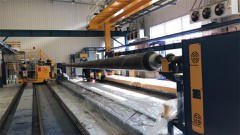
At the core of the machine is the mandrel, which serves as the internal support structure for the fiberglass pipe during the winding process. The mandrel rotates at a controlled speed, and the fiberglass rovings are fed onto it in a pre - determined pattern. This pattern is crucial as it determines the mechanical properties and structural integrity of the final pipe product.
Machine Components and Their Functions
Creel System
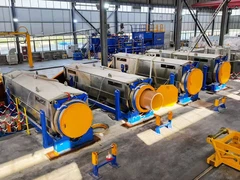
The creel system is the starting point of the winding process. It is responsible for holding multiple spools of fiberglass rovings. These rovings are the raw material for the pipe production. The creel must ensure a smooth and consistent supply of the rovings to the rest of the machine. It has tension control mechanisms to prevent the rovings from breaking or becoming slack during the winding operation.
Resin Bath
Once the fiberglass rovings are fed from the creel, they pass through a resin bath. The resin bath contains a specialized resin, typically a thermosetting resin such as epoxy or polyester. The purpose of this bath is to impregnate the fiberglass rovings with the resin. The resin acts as a binder, holding the fiberglass fibers together and providing additional strength and protection to the final pipe.
The resin bath has a precise temperature and viscosity control system. Maintaining the right temperature and viscosity is essential for ensuring uniform resin impregnation. If the resin is too viscous, the rovings may not be fully coated, leading to weak spots in the pipe. On the other hand, if the resin is too thin, it may drip off the rovings before reaching the mandrel.
Winding Head
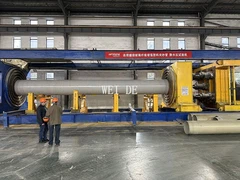
The winding head is perhaps the most critical component of the Continuous Fiberglass Pipe Winding Machine. It is responsible for precisely placing the resin - impregnated fiberglass rovings onto the rotating mandrel. The winding head can move in multiple directions, including axially along the mandrel and radially around it.
The movement of the winding head is controlled by a computer - numerical - control (CNC) system. The CNC system allows for the creation of complex winding patterns. For example, it can create helical, circumferential, or a combination of both patterns. These patterns are designed based on the specific requirements of the pipe, such as its pressure - bearing capacity, stiffness, and diameter.
Mandrel Rotation System
The mandrel rotation system provides the necessary rotational motion for the mandrel. It is designed to rotate the mandrel at a constant speed throughout the winding process. The speed of rotation is carefully calibrated based on the winding pattern and the feed rate of the fiberglass rovings. A stable rotation speed is crucial for ensuring uniform fiber distribution and consistent pipe quality.
Curing Oven
After the winding process is complete, the newly formed fiberglass pipe on the mandrel is transferred to a curing oven. The curing oven applies heat to the pipe, which initiates a chemical reaction in the resin. This reaction causes the resin to harden and bond the fiberglass fibers together permanently.


The curing process is a critical step in determining the final properties of the pipe. The temperature and duration of curing are carefully controlled. Different resins have different curing requirements, and the oven must be set to the appropriate parameters to ensure optimal curing.
The Operation Sequence
- Setup: Before starting the winding process, the operator must set up the machine. This includes loading the fiberglass rovings onto the creel, filling the resin bath with the appropriate resin, and programming the CNC system with the desired winding pattern and parameters.
- Initial Winding: Once the setup is complete, the mandrel starts to rotate, and the resin - impregnated fiberglass rovings are fed onto the mandrel by the winding head. The winding head moves according to the pre - programmed pattern, gradually building up the layers of fiberglass on the mandrel.
- Layer Building: As the machine continues to operate, multiple layers of fiberglass are wound onto the mandrel. Each layer is carefully placed to achieve the desired thickness and strength of the pipe. The number of layers and the orientation of the fibers in each layer can be adjusted based on the specific application of the pipe.
- Completion of Winding: After all the required layers have been wound, the winding process stops. The newly formed fiberglass pipe is still on the mandrel at this stage.
- Curing: The mandrel with the wound pipe is then transferred to the curing oven. The pipe remains in the oven for the specified curing time and temperature.
- Removal from Mandrel: Once the curing process is complete and the pipe has cooled down, it is removed from the mandrel. The pipe is then inspected for quality control purposes, including checking for proper fiber distribution, resin content, and dimensional accuracy.
Advantages of Our Continuous Fiberglass Pipe Winding Machines
As a supplier of Continuous Fiberglass Pipe Winding Machines, we take pride in the advanced features and benefits of our products.
- High Precision: Our machines are equipped with state - of - the - art CNC systems that can achieve extremely high winding precision. This ensures that the final pipes have consistent mechanical properties and meet the most stringent industry standards.
- Customizability: We understand that different customers have different requirements for their fiberglass pipes. Our machines can be easily customized to accommodate various pipe diameters, lengths, and winding patterns. Whether you need pipes for water supply, oil and gas transportation, or structural applications, our machines can be tailored to your needs.
- Efficiency: Our machines are designed for high - speed operation without compromising on quality. They have fast resin impregnation systems and efficient winding heads, which significantly reduce the production time per pipe. This allows our customers to increase their production capacity and meet market demands more effectively.
Applications of Fiberglass Pipes Produced by Our Machines
The fiberglass pipes produced by our Continuous Fiberglass Pipe Winding Machines have a wide range of applications in different industries:
- Water Industry: Fiberglass pipes are ideal for water supply and drainage systems due to their corrosion resistance and smooth interior surface. This reduces the risk of leaks and blockages, ensuring a reliable water supply.
- Oil and Gas Industry: In the oil and gas sector, these pipes are used for transporting oil, gas, and other fluids. Their high strength and corrosion resistance make them suitable for harsh environments and high - pressure applications.
- Construction Industry: Fiberglass pipes can be used as structural components in buildings and bridges. Their lightweight nature makes them easy to install, and their high strength - to - weight ratio provides excellent structural support.
Why Choose Our Products
We are committed to providing our customers with the best - in - class Continuous Fiberglass Pipe Winding Machines. Our machines are built with high - quality materials and advanced technology, ensuring long - term reliability and performance. We also offer comprehensive after - sales service, including technical support, maintenance, and spare parts supply.
If you are interested in our Continuous Fiberglass Pipe Winding Machine, Composite Material Winding Equipment, or Continue Filament Winding FRP Pipe Produciton Line, please feel free to reach out to us for a detailed consultation. We look forward to working with you to meet your specific manufacturing needs and help you achieve greater success in your business.
References
- "Filament Winding Technology" by Daniel T. Turner.
- "Advanced Composites Manufacturing" edited by Sia Nemat - nasser.
- Industry reports on fiberglass pipe production and manufacturing equipment.
Send Inquiry