



What are the thermal expansion properties of GRP/Frp pipe widening?
Nov 25, 2025
Leave a message
Hey there! I'm a supplier of GRP/FRP pipe widening products. Today, I wanna chat about the thermal expansion properties of GRP/FRP pipe widening.
First off, let's understand what GRP and FRP are. GRP stands for Glass Reinforced Plastic, and FRP is Fiber Reinforced Plastic. These materials are super popular in the pipe industry 'cause they're lightweight, corrosion - resistant, and have good mechanical properties.
When it comes to thermal expansion, it's a crucial factor to consider in pipe systems. Thermal expansion refers to the tendency of a material to change its shape, area, and volume in response to a change in temperature. For GRP/FRP pipes, their thermal expansion properties are quite different from traditional materials like steel or concrete.
The thermal expansion coefficient of GRP/FRP pipes is relatively low compared to metals. This is a big advantage in many applications. For example, in a piping system that experiences temperature fluctuations, a low thermal expansion coefficient means less stress on the pipes and the joints. If a pipe expands too much due to temperature increase, it can lead to issues like pipe buckling, joint failure, and leaks. With GRP/FRP pipes, these risks are significantly reduced.
The thermal expansion of GRP/FRP pipes is also anisotropic. That means the expansion rate is different in different directions. Usually, the expansion along the longitudinal direction (the length of the pipe) is much lower than the expansion in the circumferential direction (around the pipe). This anisotropy is mainly due to the way the fibers are oriented in the composite material. In most GRP/FRP pipes, the fibers are predominantly aligned along the longitudinal direction, which restricts the expansion in that direction.
Now, let's talk about how these thermal expansion properties affect the installation and use of GRP/FRP pipe widening. During installation, it's important to account for the potential thermal expansion. For instance, when laying pipes in a long - run system, expansion joints may be required to accommodate the changes in length due to temperature variations. If these joints are not properly installed or sized, it can cause problems down the line.
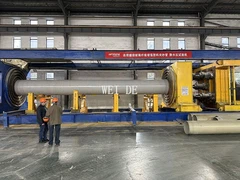
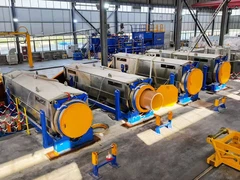
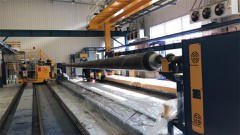
In terms of the manufacturing process of GRP/FRP pipe widening, the thermal expansion properties also play a role. We use advanced equipment like the CFW Continuous Pipe Winding Machine and the Continuous Fiberglass Pipe Winding Machine to ensure the quality and consistency of the pipes. These machines allow us to control the fiber orientation and resin content, which in turn affects the thermal expansion characteristics of the final product.
The Composite Material Winding Equipment we use is state - of - the - art. It helps us create pipes with the right balance of mechanical and thermal properties. By carefully selecting the fibers and resins and controlling the winding process, we can optimize the thermal expansion behavior of the GRP/FRP pipe widening.
Another aspect to consider is the environmental conditions. In hot climates, the pipes will experience more significant thermal expansion. On the other hand, in cold climates, the pipes may contract. Our GRP/FRP pipe widening products are designed to withstand these extreme temperature conditions. We conduct extensive testing to ensure that the pipes can perform well in different environments.


For example, we test the pipes in temperature chambers where we can simulate different temperature ranges. This helps us understand how the pipes will behave in real - world scenarios. Based on the test results, we can make adjustments to the manufacturing process to improve the thermal performance of the pipes.
When it comes to the end - users, understanding the thermal expansion properties of GRP/FRP pipe widening is essential for proper maintenance. Regular inspections should be carried out to check for any signs of stress or damage caused by thermal expansion. If any issues are detected early, they can be addressed before they turn into major problems.
In industrial applications, such as chemical processing plants or power generation facilities, the thermal expansion of pipes can have a significant impact on the overall system performance. GRP/FRP pipes are a great choice in these settings because of their low thermal expansion and corrosion resistance. They can handle the harsh chemicals and high - temperature environments without deteriorating quickly.
In the water and wastewater industry, GRP/FRP pipes are also widely used. The thermal expansion properties ensure that the pipes can maintain their integrity over time, even when exposed to different water temperatures. This reduces the need for frequent repairs and replacements, saving both time and money for the operators.
If you're in the market for GRP/FRP pipe widening products, it's important to choose a reliable supplier. We've got years of experience in the industry and a team of experts who are dedicated to providing high - quality products. Our products are designed to meet the highest standards in terms of thermal expansion and other performance criteria.
Whether you're working on a small - scale project or a large - scale industrial installation, we can offer you the right solutions. We can customize the pipes according to your specific requirements, taking into account factors like the expected temperature range, the pressure in the system, and the chemical environment.
So, if you're interested in our GRP/FRP pipe widening products, don't hesitate to reach out. We're here to answer all your questions and help you make the best choice for your project. Let's start a conversation and see how we can work together to achieve your goals.
References
- "Handbook of Composite Materials for Engineers"
- "Thermal Properties of Polymer - Matrix Composites"
- Industry reports on GRP/FRP pipe applications
Send Inquiry