



What is the impact of humidity on 3D printed GRP pipes?
Oct 10, 2025
Leave a message
Humidity is an environmental factor that often goes unnoticed but can have a profound impact on various manufacturing processes, including 3D printing of Glass Reinforced Plastic (GRP) pipes. As a 3D print GRP pipe supplier, I've witnessed firsthand how humidity levels can influence the quality, durability, and overall performance of these pipes. In this blog post, I'll delve into the science behind humidity's effects on 3D printed GRP pipes and discuss how we can mitigate these challenges to ensure the production of high - quality products.
Understanding GRP Pipes and 3D Printing
GRP pipes are made by combining glass fibers with a polymer resin matrix. The glass fibers provide strength and stiffness, while the resin binds the fibers together and protects them from environmental damage. 3D printing technology has revolutionized the production of GRP pipes by allowing for complex geometries, reduced waste, and faster production times.
In the 3D printing process of GRP pipes, a continuous filament winding technique is often employed. This involves winding continuous glass fibers impregnated with resin around a rotating mandrel to build up the pipe wall layer by layer. The quality of the final product depends on many factors, and humidity is one of the critical ones that can affect the entire process.
The Impact of Humidity on Resin Curing
One of the most significant ways humidity affects 3D printed GRP pipes is through its influence on resin curing. Resin curing is a chemical reaction that transforms the liquid resin into a solid state. Humidity can disrupt this process in several ways.
When the humidity is high, water vapor in the air can be absorbed by the resin. This can lead to a phenomenon known as hydrolysis, where the water molecules react with the resin's chemical bonds, breaking them down. As a result, the curing process may be incomplete, leading to a weaker and less durable pipe. The pipe may have reduced mechanical properties, such as lower tensile strength and flexural strength, which can compromise its performance in real - world applications.
On the other hand, low humidity can also cause problems. In a dry environment, the resin may cure too quickly. This can lead to internal stresses within the pipe as the outer layers harden faster than the inner layers. These internal stresses can cause cracking and delamination over time, reducing the pipe's lifespan.
Effect on Fiber - Resin Bonding
The bond between the glass fibers and the resin is crucial for the structural integrity of GRP pipes. Humidity can have a direct impact on this bond.
High humidity can create a thin layer of water on the surface of the glass fibers. This water layer can prevent the resin from properly wetting the fibers, leading to poor adhesion. As a result, the fibers may not be fully embedded in the resin matrix, and the pipe may experience fiber pull - out under stress. This significantly reduces the pipe's ability to withstand loads and increases the risk of failure.
In addition, humidity can also affect the chemical compatibility between the fibers and the resin. Some resins are more sensitive to humidity than others, and in high - humidity conditions, the chemical interaction between the fibers and the resin may be altered, further weakening the bond.
Influence on Dimensional Stability
Humidity can also affect the dimensional stability of 3D printed GRP pipes. When the pipes absorb moisture from the air, they can expand. This expansion can be uneven, especially if the humidity levels vary across the pipe's cross - section. As a result, the pipe may become out of round or have inconsistent wall thickness.
In applications where precise dimensions are required, such as in plumbing systems or industrial pipelines, these dimensional changes can cause problems. For example, an out - of - round pipe may not fit properly into fittings, leading to leaks and reduced system efficiency.
Mitigating the Impact of Humidity
As a 3D print GRP pipe supplier, we take several measures to mitigate the impact of humidity on our products.
First, we control the humidity in our manufacturing environment. We use humidity - controlled chambers where the 3D printing process takes place. By maintaining a stable humidity level within a specific range, we can ensure consistent resin curing and fiber - resin bonding. This helps to produce pipes with uniform quality and performance.
Second, we select resins that are more resistant to humidity. Some advanced resin formulations have been developed to minimize the effects of hydrolysis and other humidity - related issues. By using these high - performance resins, we can improve the durability and reliability of our GRP pipes.
Third, we conduct thorough quality control checks on our products. We use non - destructive testing methods, such as ultrasonic testing and X - ray inspection, to detect any internal defects that may be caused by humidity. This allows us to identify and reject any sub - standard pipes before they are shipped to our customers.
The Role of Equipment in Humidity Management
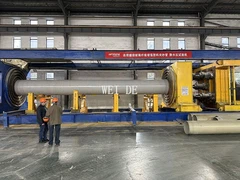
In our manufacturing process, the equipment we use also plays a crucial role in managing the impact of humidity. For example, the Composite Material Winding Equipment we employ is designed to ensure precise control over the fiber - winding process. It can operate in a controlled environment, minimizing the exposure of the resin and fibers to external humidity.


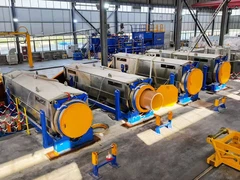
The Continue Filament Winding FRP Pipe Produciton Line is another important part of our setup. It allows for continuous production of GRP pipes with consistent quality. The line is equipped with sensors and monitoring systems that can detect changes in environmental conditions, including humidity, and adjust the production process accordingly.
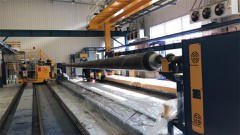
The Continuous Fiberglass Pipe Winding Machine is specifically designed to handle the winding of glass fibers impregnated with resin. It can maintain a stable temperature and humidity within the winding area, ensuring optimal resin curing and fiber - resin bonding.
Conclusion
Humidity is a significant factor that can affect the 3D printing of GRP pipes in many ways. From resin curing and fiber - resin bonding to dimensional stability, the impact of humidity can be far - reaching. However, by understanding these effects and taking appropriate measures to control humidity, we can produce high - quality GRP pipes that meet the strictest industry standards.
As a 3D print GRP pipe supplier, we are committed to providing our customers with the best products possible. If you are in the market for high - quality 3D printed GRP pipes, we invite you to contact us for a detailed discussion about your requirements. Our team of experts will be happy to assist you in finding the right solution for your project.
References
- Ashby, M. F., & Jones, D. R. H. (2012). Engineering Materials 1: An Introduction to Properties, Applications and Design. Butterworth - Heinemann.
- Mallick, P. K. (2008). Fiber - Reinforced Composites: Materials, Manufacturing, and Design. CRC Press.
- Strong, A. B. (2008). Plastics Materials and Processing. Pearson Prentice Hall.
Send Inquiry