




Analysis of the Differences Between Continuous Filament Winding Machines
Jul 15, 2025
Leave a message
Continuous filament winding machines are key equipment in composite material manufacturing, and their technological differences directly impact product performance and production efficiency. Different types of winding machines differ significantly in structural design, control accuracy, and application scenarios, requiring selection based on specific needs.
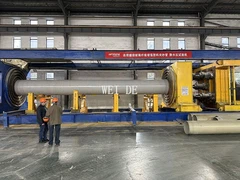
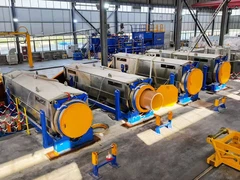
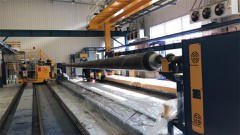
Based on structural type, continuous filament winding machines are primarily categorized into three types: horizontal, vertical, and planetary. Horizontal winding machines are suitable for long tubular or cylindrical components. Their horizontal layout facilitates material transport, but due to gravity, interlayer pressure distribution is less uniform. Vertical winding machines, with their vertical rotating axis, effectively overcome gravity interference, making them more suitable for the manufacture of large storage tanks or pressure vessels, and providing superior interlayer bonding. Planetary winding machines combine rotational and translational motion to produce complex, custom-shaped parts, such as tapered tubes or hyperbolic structures, but their control systems are more complex.
Control technology is another key differentiator. Traditional mechanical winding machines rely on preset programs, enabling only fixed-angle winding and lacking flexibility. Modern CNC winding machines, however, utilize servo motors linked to computer-aided design (CAD) to support variable angles, variable tension, and multi-path coordinated control, precisely matching diverse fiber placement requirements. Furthermore, some high-end models integrate online monitoring modules for real-time adjustment of winding parameters to ensure product consistency.
The application also influences equipment selection. The aerospace industry favors high-precision, multi-degree-of-freedom planetary winding machines to meet lightweight and high-strength requirements. The chemical industry prioritizes vertical winding machines for corrosion resistance and high-volume molding capabilities.
In summary, the differences between continuous filament winding machines lie in their structural design, level of intelligence, and industry adaptability. Users must balance cost, precision, and functionality requirements to select the most suitable technical solution.
Send Inquiry