




Composite Winding Equipment: A Key Tool for Modern Manufacturing Technology
Jul 28, 2025
Leave a message
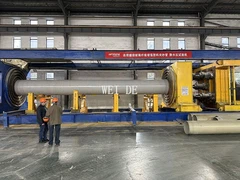
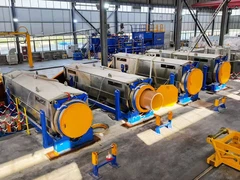
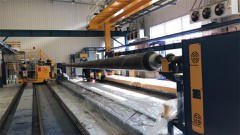
Composite winding equipment is core equipment for manufacturing high-performance fiber-reinforced composite products, widely used in aerospace, energy pipelines, the automotive industry, and high-end sports equipment. By precisely controlling the winding path and tension of the fiber tow, this equipment combines a resin matrix with reinforcing materials (such as carbon fiber and glass fiber), ultimately creating structural components with high strength, lightweightness, and corrosion resistance.
Based on the technical principles, composite winding equipment is primarily categorized as wet winding and dry winding. Wet winding impregnates fiber tows with resin and then directly winds them onto a mold surface. This flexible and cost-effective process is suitable for small and medium-volume production. Dry winding, on the other hand, uses pre-impregnated fiber tapes and heat-cures them, offering higher precision and repeatability. It is commonly used in demanding applications such as aerospace. The equipment's core functions include fiber tension control, path planning, and temperature/pressure regulation. The tension control system directly affects the mechanical properties of the product, while multi-axis linkage technology enables precise winding of complex curved structures.
Modern composite winding equipment often integrates automation and digital technologies. Using industrial robots or CNC systems, the equipment can perform three-dimensional spiral, hoop, and planar winding according to preset programs, while also monitoring key parameters such as resin content and fiber volume fraction in real time. Some high-end models are also equipped with online inspection modules, such as infrared thermal imagers or ultrasonic flaw detectors, for defect identification and quality control. Furthermore, the modular design concept enables rapid switching of molds and process parameters to meet the customized needs of different products.
Against the backdrop of continuous breakthroughs in materials science, winding equipment is developing towards high precision and intelligent technologies. For example, AI-based process optimization algorithms can predict stress distribution during winding, reducing trial production costs. The introduction of green manufacturing technologies reduces environmental impact through low-energy curing processes and resin recovery systems. With the expanding application of composite materials in emerging fields such as new energy (such as hydrogen storage tanks) and rail transportation, the market demand for high-performance winding equipment continues to grow.
In short, composite winding equipment is not only a key link in the high-end manufacturing industry chain but also a vital tool for promoting lightweight design and sustainable technology advancements. Its technological evolution will directly determine the performance boundaries and application breadth of composite products, presenting broad potential for innovation through the cross-disciplinary integration of multiple disciplines.

Send Inquiry