

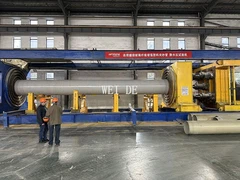


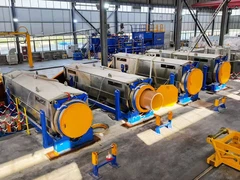
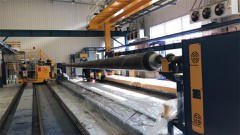

Centrifugally Cast FRP Pipe Production Line Solutions
Jul 27, 2025
Leave a message
Centrifugally cast FRP pipes are widely used in water supply and drainage, chemical, and power industries due to their excellent corrosion resistance, lightweight, high strength, and long life. However, their production requires extremely high process control, equipment precision, and material ratios. Therefore, an efficient and stable production line solution is crucial.
I. Core Process Optimization
The core of centrifugally cast FRP pipe production lies in the uniform mixing of resin, glass fiber, and filler, followed by high-speed centrifugal molding. This solution requires an automated batching system to ensure precise raw material ratios and avoid product performance fluctuations due to human error. Furthermore, the mold preheating system requires precise temperature control, typically maintained within a range of 80-120°C, to ensure full resin curing and form a dense inner lining. The centrifuge speed should be adjusted according to the pipe diameter, generally between 800-1500 rpm, to ensure even material distribution and form a high-strength structural layer.
II. Equipment Selection and Layout
The production line should be equipped with a high-rigidity centrifuge and utilize variable frequency drive technology to accommodate the production needs of pipes of varying specifications. The mold system must feature a quick-change function to reduce mold change time and improve production efficiency. Furthermore, the curing oven should utilize electric or gas heating to ensure continued curing of the pipe after demolding, achieving optimal mechanical properties. The entire production line layout should adhere to the principles of "continuous and compact," ensuring streamlined operations from raw material mixing to finished product cutting, minimizing logistical losses in intermediate links.
III. Quality Control and Testing
To ensure product quality, the production line must integrate an online monitoring system to monitor resin content, wall thickness uniformity, and degree of cure in real time. Ultrasonic thickness gauges and spark leak detectors should be used for non-destructive testing of the pipes to ensure the absence of defects such as delamination and bubbles. Finished products must undergo hydrostatic testing and Barcol hardness testing in accordance with relevant standards such as GB/T 21238-2016.
IV. Environmental Protection and Energy-Saving Measures
Volatile organic compounds (VOCs) generated during the production process must be treated through a negative pressure collection system using activated carbon adsorption or catalytic combustion technology to ensure compliance with emission standards. Furthermore, a waste heat recovery system can utilize waste heat from the curing oven to preheat raw materials or molds, reducing energy consumption.
Conclusion
Centrifugally cast FRP pipe production line solutions require a combination of process optimization, equipment automation, and strict quality control to achieve efficient, stable, and environmentally friendly production. Through technological upgrades and management innovations, product competitiveness can be significantly enhanced to meet market demand for high-quality FRP pipes.

Send Inquiry