




Precautions for Centrifugal Casting FRP Pipe Production Lines
Jul 26, 2025
Leave a message
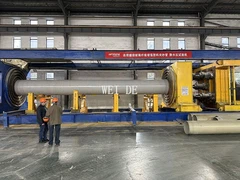
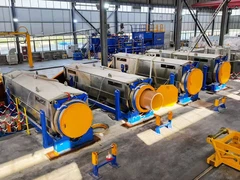
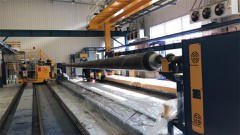
Centrifugal casting FRP pipe production lines are highly efficient, continuous production equipment widely used in municipal engineering, chemical engineering, and power generation. The production process involves high temperatures, high-speed rotation, and chemical material handling, requiring strict adherence to operating procedures to ensure product quality and personnel safety. The following are key considerations for operating this line.
1. Raw Material Preparation and Mixing Control
The raw materials for FRP pipes primarily consist of resin, glass fiber, and filler. Before adding materials, the resin type, viscosity, and curing agent ratio must be strictly checked to ensure they meet process requirements. The resin-to-curing agent ratio directly affects the strength and corrosion resistance of the pipe. Improper mixing can lead to incomplete curing or cracking. Furthermore, uniform distribution of the glass fiber is crucial. Automated equipment or manual assistance is required to ensure uniform fiber distribution within the mold to avoid localized defects.
2. Mold and Equipment Inspection
During the centrifugal casting process, the high-speed rotation of the mold plays a crucial role in production stability. Before each run, the mold's integrity must be inspected for cracks, deformation, or wear. The mold's sealing must also be carefully monitored to prevent resin leakage that could affect product quality. Furthermore, the centrifuge's bearings, drive system, and motor should be regularly maintained to ensure stable rotational speed and avoid excessive vibration that could lead to uneven pipe wall thickness or equipment failure.
3. Process Parameter Control
Core process parameters for centrifugal casting include rotation speed, temperature, and time. Too low a rotation speed can lead to uneven glass fiber settling, while too high a rotation speed can cause mold resonance or resin splashing. Temperature control directly affects the resin's curing speed, and the heating system must be adjusted according to the resin type to ensure a uniform curing process. Furthermore, the casting time must be precisely controlled to avoid premature mold release, which could result in insufficient pipe strength, or late mold release, which could affect production efficiency.
4. Safe Operation and Environmental Protection
Centrifuges pose significant mechanical risks when operating at high speeds. Operators must wear protective equipment such as hard hats, goggles, and earplugs. Emergency stop devices should be installed in production lines, and regular safety drills should be conducted. Furthermore, resins and curing agents are often flammable or hazardous chemicals. Operations must be performed in a well-ventilated environment equipped with fire prevention and spill emergency equipment to ensure compliance with environmental regulations.
5. Finished Product Inspection and Quality Control
After production is completed, the pipes should be visually inspected to ensure they are free of bubbles, cracks, or delamination. Additionally, sampling should be conducted to test the pipes' hoop stiffness, compressive strength, and corrosion resistance to ensure compliance with industry standards. Unqualified products should be promptly reworked or scrapped to avoid compromising project safety.
In summary, the stable operation of a centrifugally cast FRP pipe production line relies on strict raw material management, equipment maintenance, process control, and safety management. Only by fully adhering to operating regulations can product quality be guaranteed, equipment life extended, and the production process safe and efficient.
Send Inquiry