




Classification and Analysis of Continuous Filament Winding Machines
Jul 11, 2025
Leave a message
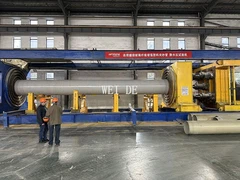
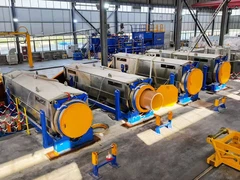
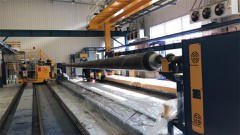
Continuous filament winding machines, as key equipment in the composite material manufacturing industry, are widely used in the production of products such as pipes, storage tanks, and pressure vessels. Based on different technical principles and application scenarios, continuous filament winding machines can be divided into various types, each with significant differences in structural design, control methods, and applicable materials.
Based on their motion, continuous filament winding machines are primarily categorized as planar winding machines, hoop winding machines, and spiral winding machines. Planar winding machines achieve regular fiber winding through the planar motion of the winding nozzle and are suitable for manufacturing cylindrical or nearly cylindrical products. Hoop winding machines wind at a constant angle along the circumference of the mandrel and are often used to enhance the axial strength of the product. Spiral winding machines combine rotation with axial feed motion to produce tubular or conical containers with high hoop strength and are widely used in the petrochemical and natural gas industries.
Based on their control method, continuous filament winding machines can be categorized as mechanical, CNC, and intelligent. Mechanical winding machines rely on pre-set mechanical transmission mechanisms and are suitable for standardized production. CNC winding machines use computer programs to precisely control the winding path and tension, significantly improving production flexibility and precision. Intelligent winding machines integrate sensors and adaptive algorithms, enabling real-time adjustment of process parameters to meet the manufacturing requirements of complex structural parts.
Furthermore, winding machines can be categorized as vertical or horizontal, depending on the mandrel drive type. Vertical machines are suitable for large cylindrical products, while horizontal machines are more suitable for processing small or irregularly shaped components. Each type of continuous filament winding machine has its own advantages, and users should select the appropriate model based on their specific production needs to achieve efficient and precise composite molding.
Send Inquiry