




Working Principle of a Four-Dimensional Wrapping Machine
Jul 24, 2025
Leave a message
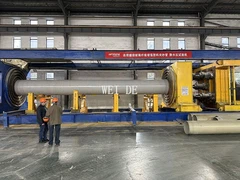
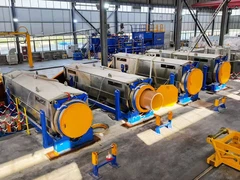
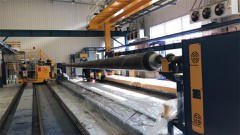
A four-dimensional wrapping machine is an advanced automated wrapping machine primarily used for spiral or longitudinal winding of materials such as composite materials, plastic films, and metal wire.Compared to traditional three-dimensional wrapping machines, a four-dimensional wrapping machine incorporates a time variable in addition to the spatial dimension, enabling dynamic adjustment of the winding path and tension based on real-time feedback, thereby achieving more precise forming control.
Its operating principle is based on a multi-axis linkage control system, typically consisting of a winding head, a material supply system, a tension control system, and a computer numerical control (CNC) unit. The winding head incorporates a rotational axis (usually the A or C axis) in addition to the three linear axes (X, Y, and Z). This allows for flexible adjustment of the winding path in three dimensions and dynamic optimization over time. The material supply system ensures uniform delivery of wire, film, or fiber to the wrapping head, while the tension control system uses sensors to monitor material tension in real time, ensuring stability during the winding process.
The core advantage of a four-dimensional wrapping machine lies in its intelligent control capabilities. Using built-in algorithms, the machine automatically calculates the optimal winding path based on the workpiece geometry, material properties, and process requirements, adjusting parameters such as line speed, winding angle, and interlayer overlap in real time during operation. This dynamic adjustment capability makes 4D wrapping machines particularly suitable for forming complex curved structures, such as aerospace components, lightweight automotive components, and high-end pipe winding.
Furthermore, 4D wrapping machines are often equipped with visual inspection or laser ranging systems to further optimize wrapping accuracy. By integrating multi-dimensional data, the machine can adaptively adjust at different process stages to ensure uniformity and mechanical properties of the final product.
In short, by integrating spatial and temporal variables, 4D wrapping machines achieve high-precision and efficient automated wrapping, making them a vital piece of technical equipment in modern advanced manufacturing.
Send Inquiry